The Great Place To Work Effect
Trust isn’t soft. It predicts performance. When leaders build trust, employees thrive—and business performance follows.
The Great Place To Work Effect is the proven relationship between high-trust leadership, exceptional employee experiences, and superior business performance. Built on more than 30 years of Trust Index™ research, it explains why some organizations consistently outperform—and provides a blueprint for creating those results in your organization.
3x
Stock-market outperformance
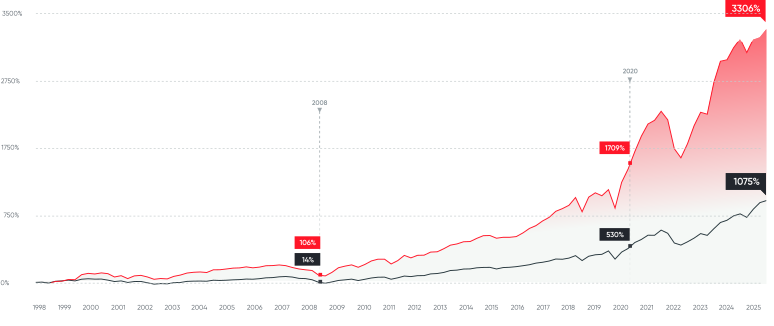
Fortune 100 Best Companies to Work For vs. Russell 1000 Index, 1998-2025
8.5x
Higher revenue per employee
Fortune 100 Best companies earn an average $883,928 revenue per employee compared to $104,030 average for the U.S. public market
7.5x
Higher YOY revenue growth
A 2025 Study of U.S. Certified companies with less than 100 employees and high leadership effectiveness scores
Who is Great Place To Work
Great Place To Work helps organizations build high-trust workplaces that drive better business results. Backed by more than 30 years of research and one of the world’s largest workplace datasets, we equip leaders with the insights, benchmarks, recognition, and guidance needed to strengthen leadership effectiveness, improve the employee experience, attract and retain top talent, and unlock the full potential of their people.
23,000
Customers
Today, we work with more than 23 thousand companies around the world.
25 Million
Employees Represented
We’ve surveyed more than 25 Million people.
180+
Countries & Regions
We've captured this feedback in dozens of languages across 180+ countries.
What is the Great Place To Work Effect?
The Great Place To Work Effect is the proven relationship between high-trust leadership and business performance. Great leaders build trust, trust shapes employee experience, experience creates culture, and culture drives performance. This is not a theory. It is a repeatable chain of cause and effect, validated across industries, geographies, and company sizes. When you dig into the performance of the world’s most successful companies, you find a consistent pattern that any business can emulate.
01
Leadership Behaviors
Trust starts with leaders. Our research has identified the nine leadership behaviors that consistently build trust and influence how employees experience work every day. These behaviors impact everything—and they are measurable and repeatable.
02
Employee Experience
Leadership shapes the three most important workplace relationships: trust in leaders, pride in work, and camaraderie with colleagues. These relationships define the employee experience and determine whether employees bring their best ideas, energy, and commitment to work.
03
Workplace Culture
Over time, those experiences create culture. High-trust cultures encourage collaboration, innovation, agility, belonging, and well-being – not because they’re declared in company values, but because employes experience them consistently.
04
Business Performance
Finally, culture drives business performance. Organizations with high-trust cultures outperform in profitability, productivity, innovation, retention, customer experience, resilience, and long-term financial performance.


“We take a lot of pride in partnering with Great Place To Work. Our company loves it. It’s our way to continue to get better and thrive as a business.”
Annette Alexander
Chief People Officer, WP Engine


"I think of trust as the ultimate form of resiliency for a business.”
Chris Nassetta
President and CEO,
Hilton


“Fundamentally, it does come down to your people—their skills, their engagement—to make you successful.”
Julie Sweet
CEO, Accenture


“I can’t tell you how big of an effect Great Place To Work has had on Trek. You can go leader by leader. The best leaders have the best Great Place To Work scores.”
John Burke
CEO at Trek Bicycle
Why the Great Place To Work Effect Matters More Than Ever
Organizations are facing unprecedented pressure to transform. AI is changing how work gets done. Employees expect greater flexibility. Markets are volatile. Change is constant.
Business leaders know the headwinds they face. Every business must continually become more efficient, more resourceful, more innovative—or risk extinction.
Technology can certainly accelerate transformation, but only people make transformation successful. Organizations with high levels of trust adapt faster, embrace change more readily, and execute strategy more effectively because employees believe in their leaders and each other.
Trust has become one of the few competitive advantages competitors can’t easily copy.
"The Great Place To Work Effect is the tangible and transformative impact of a workplace where people genuinely enjoy working together, trust their leaders, and feel inspired by their work.”
Marcus Erb
VP of Data Science & Innovation, Great Place To Work
The Business Case for Trust
Across industries, geographies, and company sizes, high-trust organizations consistently outperform their peers.
3× Stock Market Performance
Fortune 100 Best Companies to Work For compared with the Russell 1000 Index (1998–2025).

8.5x Higher Revenue Per Employee
Fortune 100 Best Companies to Work For compared with the U.S. Public Market

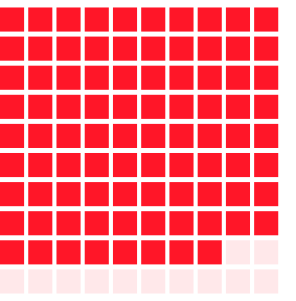
Fortune 100 Best (RPE)
$883,928

U.S. Public Market (RPE)
$104,030
At Small Companies, High-Trust Leadership Drives 7.5x Revenue Growth
For small businesses (10–99 employees), when leadership effectiveness is high, revenue growth is 7.5x higher.

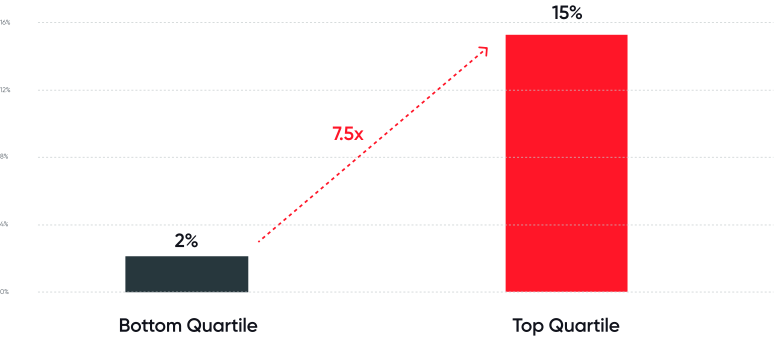
Based on a study of all Certified companies with less than 100 employees (as of Jan 2025) that have self-reported their annual US revenue.
The most successful businesses have higher levels of revenue per employee (RPE) – a common metric for analyzing efficiency and productivity. At the 2025 Fortune 100 Best Companies to Work For, RPE is 8.5x higher than the U.S. public market. But the strong financial performance of high-trust workplaces can be seen in organizations of all sizes. For small businesses with less than 100 employees, when leadership effectiveness is high, revenue growth is 7.5x higher. At medium-sized businesses, we see the same pattern: high-trust leadership drives 3.4x higher revenue growth.
Why we Measure Trust, not Employee Engagement
Great Place To Work’s products and services enable companies all over the world to measure and improve trust across their workforce. While many companies use employee engagement as a metric to track performance, employee engagement offers an incomplete picture of the employee experience. Why are your people engaged or disengaged? And what can you actually do about it?
Engagement tells leaders how employees feel today. Trust predicts how organizations will perform tomorrow and provides an early warning signal that can help your leadership team get ahead of declining employee engagement, loss of top talent, and the poor business performance that comes with it.
Organizations with higher trust consistently achieve better business performance because trust changes how people respond to change, to each other, and to the work itself.
For the best outcomes, companies want to create a workplace where employees have high levels of trust and give their maximum level of effort. Every small increase in trust can help drive better outcomes for your business. Companies that become Great Place To Work Certified can measure and pinpoint the paths that lead to improved agility, innovation, and productivity for their employees.
Trust Fuels Performance
Higher trust drives stronger performance, helping employees give more effort and businesses achieve better outcomes.

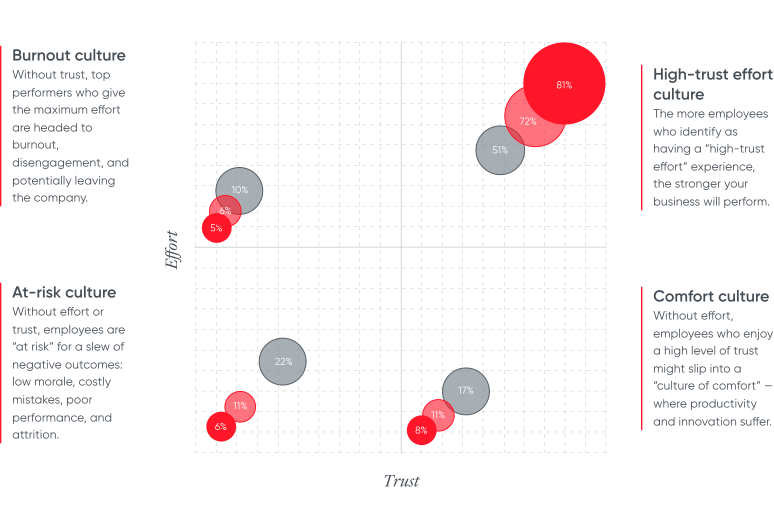
Source: 100 Best Companies data is based on the 2025 Fortune 100 Best Companies to Work For List produced by Great Place To Work, which analyzed 670,000 survey responses from companies that are Great Place To Work Certified. Great Place To Work Certified companies data is based on feedback from 1.3 million U.S. employees whose organizations earned Great Place To Work Certification in 2024.
Typical companies data is based on a randomized sample of more than 5,000 part- and full-time U.S. employees.
Trust Unlocks Agility, Innovation & Productivity
81% Adapt Quickly to Change
Nearly three-quarters (72%) of business leaders say their business doesn’t move fast enough.* At Certified companies, 81% of employees adapt quickly to change vs. 64% at typical companies.

Certified vs. Typical companies

Source: Certified companies refers to data from a study of all companies with active Certification in 2024 (1.3 million employees surveyed). Typical workplaces refers to data from the 2025 U.S. Normative Survey, in which 5,000+ U.S. employees at non-Certified workplaces were surveyed.
Aon, Business Decision Maker Survey (2024).*
How ready is your workforce to turn ideas into action?
The Innovation Velocity Ratio reveals how many employees are empowered to innovate compared with those experiencing friction. The higher the ratio, the greater an organization’s ability to adapt, act on ideas, and drive change.
11:2
Accelerated Ratio
11 employees ready to innovate for every 2 experiencing friction.
Innovation is widespread. Employees are empowered to act on ideas, adapt quickly, and drive change.
5:2
Functional Ratio
5 employees ready to innovate for every 2 experiencing friction.
The organization is moving forward, but barriers still slow progress. Ideas emerge, yet execution and adaptation can be inconsistent.
3:2
Friction Ratio
3 employees ready to innovate for every 2 experiencing friction.
Too many barriers get in the way, making it harder for employees to act on ideas and adapt to change.
Source: Great Place to Work®, “Innovation By All: The New Flight Plan for Elevating Ingenuity, Accelerating Performance, and Outpacing Rivals,” Innovation Insights Series, Part 1 of 4 (2018).
Higher Levels of Trust Inspire more Discretionary Effort
Companies spend at least three times as much annually on talent compared to capital expenses like machinery or facilities.* As a result, productivity is a key driver of overall profitability for your company. At Certified companies, nearly nine in 10 employees (85%) give extra effort compared to just six in 10 (60%) at typical U.S. companies—an increase of 42%.
85%
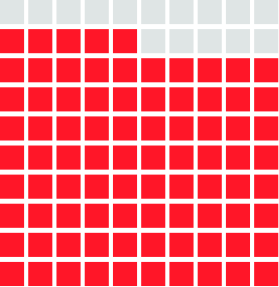
60%

Source: Certified companies refers to data from a study of all companies with active Certification in 2024 (1.3 million employees surveyed). Typical workplaces refers to data from the 2025 U.S. Normative Survey, in which 5,000+ U.S. employees at non-Certified workplaces were surveyed.
McKinsey & Company*
The Great Place To Work Effect in the Age of AI
AI is rapidly changing the workplace. But successful AI adoption depends more on trust than technology. Employees embrace new tools when they trust leadership's intentions, believe change is fair, and feel psychologically safe experimenting and learning. Organizations that build trust won't simply adopt AI faster—they'll also realize greater value from it.
Build the Conditions that Drive Performance
Understanding the Great Place To Work Effect is only the beginning. Great Place To Work helps organizations measure trust, strengthen leadership, improve their culture, and amplify business success. Learn more about our platform and offerings today.
Get Your Free Action Guide
- Behavior-level drivers, ranked by impact
- Self-scoring worksheet against the benchmark
- A prioritized 90-day starting plan
Your action guide will be delivered instantly via email.
Thank you!
Your submission was successful. Your Action Guide is ready to download.
Common Questions
Yes. Companies with high-trust cultures consistently outperform their competitors across financial performance, innovation, agility, and resilience, and this is true for companies of every size. Companies that make the Fortune 100 Best Companies to Work For List consistently outperform the market, by 3x over a 28-year period, according to FTSE Russell, the global index and data provider*. The advantage extends to smaller organizations too: Great Place To Work research across more than 1,000 SMBs found that in small businesses, when leadership effectiveness is higher, year-over-year revenue growth is 7.5 times higher*. In our research, a more positive employee experience preceded the positive gains those companies later saw, meaning great culture drives performance, not the other way around.
Trust is the foundation that makes engagement meaningful and durable, while engagement alone offers only a partial view of the employee experience. Without the intentionality of leaders and the foundation of trust, engagement is fragile — it fluctuates with surface-level perks or temporary morale boosts. The key distinction is predictive power: companies that measure trust with Great Place To Work can use employee survey data as a leading indicator of business performance. Trust is an early warning sign that can help your leadership team get ahead of declining employee engagement, loss of top talent, and the poor business performance that comes with it. In short, unlike engagement, trust is systemic and measurable. It's also predictive — if your trust score drops, you're likely to see metrics such as turnover go up.
The Great Place To Work Trust Index Survey measures the level of trust in your organization and the consistency of the employee experience — in other words, how often employees can count on things like clear and honest leadership, fair treatment, and recognition. Survey answers are assessed on a five-point scale, revealing the most common experience of employees in the organization. Employee scores are averaged to provide an organization-wide assessment of workplace culture: the Trust Index score. The result is a benchmarked, data-driven view of your culture that reveals both strengths and opportunities for improvement.
Yes. Companies that make the Fortune 100 Best Companies to Work For List consistently outperform the market by 3x over a 28-year period, according to FTSE Russell, the global index and data provider*. This advantage holds across market cycles: over 28 years, the 100 Best produced an annualized return of 13.4% compared to about 9.2% for the Russell 3000. High-trust workplaces are also more resilient during downturns — during downturns like the 2008 recession and the COVID-19 pandemic, high-trust companies not only survived — they thrived — including 100 Best Companies gaining a competitive advantage of more than 2,000% in cumulative returns following the pandemic.
You put the Great Place To Work Effect to work by measuring trust, giving leaders clear and prescriptive insights to act on, and building a consistently positive experience for every employee. When you dig into the performance of the world's most successful companies, you find a repeatable pattern that any business can follow: Great leaders build trust, which shapes the culture, which drives performance. It all tarts with measurement: trust is measurable and actionable through the GPTW Trust Index. And because employee experience is driven by the leaders in your organization, the most direct path forward is equipping those leaders with their team's feedback and clear next steps. Companies that work with us outperform on nearly every business metric because they are equipped to create high-trust workplaces.