


High-trust leadership, Leadership & Management, Purpose
Many HR leaders ask themselves the same question: How do we help employees feel that their work matters?
Purpose isn’t a feel-good idea; it’s a business strategy that drives retention, productivity, and engagement.
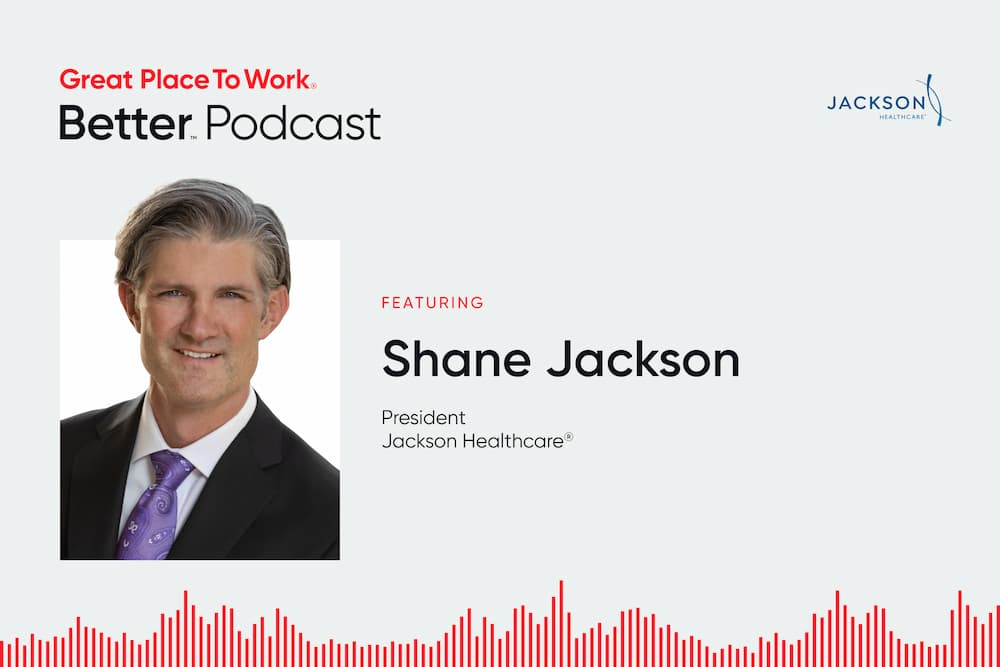
While meaningful work drives those outcomes, Shane Jackson, president of Jackson Healthcare, a Fortune 100 Best Company, reminds us that purpose begins long before anyone logs into work.
On this episode of the Better Podcast from Great Place To Work®, he talks about how personal purpose and workplace purpose shape each other — and why that connection matters for leaders today.
Purpose at work is a business imperative
Jackson defines purpose as the intersection of three things: what you’re passionate about, what you’re good at, and the impact you have on others.
Jackson reminds us that leaders can’t give employees purpose: “You cannot give purpose to other people … That’s a very personal thing,” he says.
What leaders can do is provide clarity about the mission, job expectations, and how each person’s work contributes to something meaningful.
When employees connect personally to what the organization is trying to do, they stay, grow, and contribute at higher levels, he says.
“We have a lot of really smart, hardworking people who have said, what this company is trying to do resonates with me personally,” he explains.
If people feel their work matters, they're nearly 300 % more likely to stay with their company. Couple purpose with clear direction, and watch profits soar.
Values shape performance
At Jackson Healthcare, values aren’t posters on a wall. They show up in leadership training, 360-degree feedback, and goal setting and performance expectations.
While that level of structure might sound “corporate,” Jackson says, it signals that values matter just as much as results, so they deserve the same level of clarity and accountability.
The company also reshaped what success means. Instead of measuring leaders only on short‑term results, success comes down to two things: sustainable growth and meaningful impact.
Leaders are asked: Did your decisions help the company grow now and set us up to grow well in the future? And did you make a meaningful difference for the people who depend on you—customers, associates, and other stakeholders?
Rituals bring purpose into everyday life
Jackson admits he slides into autopilot just like everyone else. What helps him stay grounded is an annual ritual: a one-day retreat each year to review how he spent his time and those choices reflected his values.
He looks at his calendar and asks: “Where am I actually spending my time today?”
He recommends others do the same: track what matters, what doesn’t fit anymore, and check in regularly to make sure your time matches your priorities in and outside of work.
Listen to the full episode of "Better by Great Place to Work" with Shane Jackson to learn how you can bring these ideas into your organization and create a purpose-driven workplace.
Roula (00:00)
Welcome to Better by Great Place to Work, the global authority on workplace culture. I'm your host, Roula Amire, content director at Great Place to Work.
We're kicking off today's conversation with an existential question. Why are we here? My guest, Shane Jackson, president of Jackson Health Care, opens his book, This Is The Thing, about life, joy, and owning your purpose the same way. We talk about goals, intention, and breaking out of autopilot so we can all make more meaningful choices in our lives. What does this have to do with work? Everything. We know that meaningful work drives retention more than pay or benefits. And at Jackson HealthCare, purpose shows up in daily habits, expectations and accountability. Shane shares some very practical tips and takeaways on how to make sure this is happening at your company. This conversation made me rethink how I spend my own time. If you're like me and you've ever wondered where your time goes or why you might be spending it on things that may not matter, this episode is for you. Enjoy.
Shane, welcome to the podcast.
Shane (01:20)
Thank you, great to be here.
Roula (01:22)
So I'm currently in my new office. I've moved recently and in the move, I got rid of a lot of things as one does when they move, including books. But one of the books that survived is yours. You made the cut. You've written a book called, This is the Thing about life, joy and owning your purpose. It debuted as an Amazon bestseller in January of 2025. So happy anniversary.
Shane (01:36)
So glad I made the cut!
Yeah, thank you, just about.
Roula (01:54)
So your book is part memoir, part self-help guide, and I'd like to start our conversation with an existential question before getting into some tips and guidance. And I can't think of a more existential question than why am I here? And this is a question you want all of us to ask ourselves. You want us to really think about how we're spending our time. And you start the book there. You start the book talking about mortality and how funerals can change the way we think about life. So to ground our conversation, if you don't mind, would you read a few sentences from page 11 on how mortality reshapes how we live?
Shane (02:37)
I am happy to and always happy to read my own words. ⁓ but yeah, I think this is the passage that you're referring to. ⁓ so the first chapter, ⁓ says the death of others reminds us that we too will die. That someday it will be my body in the box that people will gather to mourn me or worse. They won't.
Thinking about my death forces me to ask uncomfortable questions about how I am living my life. My view of death, what it means, and what I believe happens after it, ultimately determines what I do in life.
Roula (03:16)
Thank you for sharing that. What was going through your mind when you wrote that?
Shane (03:23)
I, yeah, and I kind of make the joke when I start the book that it's, it's, it's a rough way to start rough first chapter talking about death. If you can get through that chapter, then you'll be able to make it through the rest of the book. And I think there's a lot of applications of this. mean, certainly your view of death and the afterlife, ⁓ you know, the way you view your afterlife impacts the way you live. ⁓ if you think there is no afterlife and impacts the way you live.
But specifically what I was really trying to drive here was not that element. It was more thinking about the goals and the ends to which we live today. And I think for most of us, most of the time, we're just kind of acting on autopilot. But I think for a lot of people, and especially a lot of people that have maybe had a little bit more success, we start thinking about things that on their face are noble about, you know, the legacy that I'm going to leave the way that I will be remembered by future generations and that sort of thing. And while that seems noble, I think it can actually become a problem because the reality is you're not going to be remembered by future generations. Kind of past your grandkids, no one will even remember that you were here or even remember your name. And I think we fool ourselves with these things that we're chasing in our life because we think they're going to be meaningful.
And even these kind of more noble ideas of like, you know, we're going to be like, kind of lead this legacy and be remembered and all that when, when that's actually not true. And so I think when you come to terms with the reality of your mortality, that, that you're here, and then your life is over and everything that you've worked and done is done. Perhaps there's an afterlife, but in terms of what happens here, like you're not even going to be remembered. And when you come to terms with that, I think there's two possible reactions. One is that it's like super downer. Like, I mean, what's the point? I mean, okay, if nothing I do matters, nobody's going to remember me. Like everything I do here is just kind of futile. Like who cares? What's the point?
But I think there's also another reaction that's the exact opposite. Is it realizing that, okay, yeah, maybe I'm not gonna be remembered and all the great things that I did, no one's gonna know that, but you know what? Like, I'm not gonna be here to like experience that anyway, but I get something way, way more valuable. And that's to be able to experience the difference that I have in people's lives today.
Like I get to work towards all these things and these accomplishments and these things feel important. And yeah, maybe they're not going to matter beyond my life, but I still get to experience them today. Coming to terms with your mortality can lead you to say that life is meaningless or it can lead you to having incredible gratefulness that I haven't done anything to be alive, but I get to do all these amazing things in my life, experience accomplishment, experience overcoming hard things, experience rich relationships, and most of all experience the difference that I can make in other people's life. And I get to do that today. And so I think like that view on death can really help ground you in gratefulness and presence today.
Roula (07:03)
Was there a time when you felt you didn't feel like you were living a purposeful life, that it was, you said there's two ways to look at it. One, what's the point and one, it's everything. It is the whole point. Did you ever find yourself on the other side of this?
Shane (07:25)
Certainly, transparently, still, like often, there are still so many times where I find myself, like, and I sit there and go, what am I doing? Like, I wrote a book about this and I'm doing stuff that's like, just not important. Like, I mean, you know, what, like, what happens here? You know? And so I think one of the things that I've tried to really do and I encourage you in the book is to put those disciplines into my life, to raise unconscious behavior to consciousness, right? To make me sit down and go like, okay, what am I actually doing? And go like, I don't know why I'm doing this. I've got sucked into this. This is not important. And then the things that are important that do feel purposeful to me to say like, how do I lean further into those?
Roula (08:09)
Yeah, I think that's why I really enjoyed your book. There are lots of practical tips and takeaways. let's start getting into some of those. First, let's define purpose, how you define purpose. You define purpose as the intersection between passions, talents, and desired legacy. So can you expand on each of those areas and why you define purpose in these, encompassing these three elements?
Shane (08:35)
Yeah. So first of all, think you take a little bit of a step back. Like again, purpose is kind of one of these esoteric things. It feels like you just can't understand it. It's actually pretty simple concept, right? Purpose is just your desired outcome, right? Your desired result from something like I'm doing this because I want this result, right? I exercise because I want to feel healthier and you know, fit into my pants and you know, I mean, or I do this job because I want to earn money. It's just, it's just the outcome. And so when you think about purpose in your life, what you're really saying is like, what's the outcome of my life? But the way I like to phrase it is what's the desired experience I want to have in life. Right. It's like, you know, not just like in the future, it's like, what is the experience I want to have in my life? What's the most joyful version of my life that I can live?
And so I think the way to approach answering that question is through the three things that you talked about is understanding, ⁓ you know, okay, what are the things that I'm really passionate about? Like what are the things that just give me energy, right? Or I seem to have an endless source of energy to do them. Like nobody has to, you know, convince me to go do things I'm passionate about. I don't have to my alarm in the morning, right? For that, like I'm just like, let's go and I can just keep going and going. Those things I'm passionate about. The second is, as you mentioned, is my strengths, like those things that I'm just really good at, right? Like, and if you think about this from the opposite side,
It wouldn't make sense to say, hey, what's your purpose in life? Meaning, what are the things you want to do that lead to the most joyful version of your life? No one would say, I want to do stuff I hate and that I'm terrible at. No, you're like, I want to do stuff that I'm super passionate about and that I'm really good at because I always get the results I want. And then the third is, again, this idea of legacy. Legacy, we tend to think about it only in terms of when we're gone and the legacy we leave behind.
I actually think that's very important and very valuable to think about. But I really define it as simply the impact that I have on other people or the desired impact that I have on other people in the future, but also today. Like for anyone that I interact with, important people in my life, people I work with, et cetera, like what's the impact I want to have on them today? And that's my legacy with them. And so I think if you kind of think about your life through those three lenses,
It just helps clarify the choices of the things that you want to do and the things you want to start saying no to.
Roula (11:09)
Can you share some of those moments that you just talked about, how you might, you know, right size, what is your purpose and how you're spending your time in any of those three areas? If it's either, this is my strength, this is a legacy, this is a passion, just so the listener can understand when you ask yourself those questions, how you can change your day to day.
Shane (11:32)
I approach this in a few ways. One of the things I started doing several years ago is like a one-day kind of personal retreat. And so one of the big things I do in that is a really detailed review of my calendar. Because I want to start when I'm thinking about this, I want to start by like doing kind of a reality check. Like what is it that I'm doing today? Where am I actually spending my time today? And so probably like a lot of people, just keep everything on my calendar. so everything kind of goes into categories like where am I really spending my time and to try to find those things that feel kind of off purpose for me. ⁓ and then I kind of go through this process of looking at, frankly, kind of redoing annually some of the exercises that I have in the book of kind of helping me examine what these areas are. Cause by the way, they change over time, right? Things I was passionate about when I'm 20 I'm just not passionate about anymore. Right. And so, you know, context changes, right. And so it's like kind of an annual basis, really kind of relooking, asking some of these questions. Say, where am I today? What am I doing with my time? And then thinking about like kind of specific tactical things, disciplines I can put in my life to make sure I'm investing the time where I feel is most purposeful.
And then I like, I'm actually kind of weird, like I track all that stuff. I like anything that kind of makes my list of stuff I need to do, like if there's like kind of little, like very specific things. And I say, I want to do this every week or I want to do this every day. Like I have a big giant spreadsheet that I actually track it. And then I have kind of regular times where I go in and look in like, how am I, how am I doing against this? And, and you know, the things that I'm doing, I just want to, I want to be accountable. Like if it's important to me, I want to, I think it's important to keep promises that you make to yourself.
And if I'm not going like, why not? Like this obviously is not something that, that maybe is actually that important. I just thought it would be. so anyway, that's kind of what I do. It sounds like a big deal. It actually doesn't take that much time. You know, I mean, this is just like a few minutes in the morning kind of thing. ⁓ but, but for me, it's the intentionality of spending the time where I feel like is most purposeful.
Roula (13:45)
Right. And my takeaway from that is it takes a lot of intention and effort to live an intentional life. This doesn't just happen as you've just talked about. You're making it happen very diligently.
Shane (14:00)
I couldn't agree more. My team that I work with, they came up with this term for me that I'm an intention enthusiast, which I don't know if that's a thing or they just made it up, but I was like, I had to own it. was like, yeah, like I'm just, but the reason is, and I know this about me and I bet most people would say this about themselves. If I am not intentional, I just get sucked into the whirlwind of the default. You just do stuff because it's what you've always done or because it's what you think other people expect you to do or like, you know, whatever.
And then all of sudden you sit down and you look back and you go, I just wasted all that time. You know, and it's, which is, I think why this, this question of what's the most joyful version, the most joyful way you can experience life is so important because it's like, what's the thing that both in the moment and in retrospect, when I look back, I will wish I had done. And like focusing on that and then going like, okay, well, I don't want to look back and regret. So how do I make sure that I do that?
Roula (15:01)
And that's why a lot of people, you'll hear people say, sometimes myself included, where is the year gone? What have I done? It's a blur and it's a blur for a reason. ⁓ So let's talk a little bit about purpose in terms of the workplace. According to our research at Great Place to Work, meaningful work is the number one driver of retention. So if people feel their work matters, that what they do is more than just a job, they're four times or nearly 300 % more likely to stay with their company. That's twice as strong as a link between retention and salary or retention and benefits. And it's also a business driver, right? When employees believe they're making a difference, they'll work harder, they're more agile, they're more resilient. And this is all proven by the great place to work effect. So one, do you see purpose as a business imperative?
And how has that impacted the bottom line at Jackson HealthCare? So how are you infusing meaningful work into employees day to day and what is the business result of that?
Shane (16:11)
Well, first of all, I think the great place to work research that you decided coincides exactly with our experience. mean, I just think it's dead on. And I also think that when a lot of leaders have heard that kind of research and that kind of data, it has caused them to get some things completely wrong. Because I think what it's led to is this belief as a business leader, okay, all right, people are looking for purpose in work and especially younger workers that, you know, kind of leave her. And so it's my job as a leader to give them purpose. Like I have some bad news for you. You cannot get purpose to other people. That's a very personal thing. We, you know, we just talked about where that comes from. ⁓ so I can't create purpose for you.
That's something have, but as a leader, what I can do is create clarity for you of what our group's purpose is, what it is that we're trying to do and why, so that you have the opportunity based on that clarity to opt in or opt out, right? Like if this is something like, no, this fits in with what I want out of my life. Yeah, I want to be here if I don't. And by the way, like if you view it that way, that data that you just cited or people are four more times to be engaged and like, know, and all that sort of thing totally makes sense. if you are like, Hey, like, have clarity of like what I want to like experience my life. And I want to feel like I'm part of something important and something bigger or whatever. And like, I feel like in this organization, I can live that out. Like, why would you leave? mean, you'd have some other things would have to get screwed up pretty bad in order for you to leave that. And so I think it makes total sense.
But I think a lot of leaders have said like, I got to come up with this kind of high sounding purpose and whatever. like, you kind of invent this for people. ⁓ I think every organization is a purpose driven organization. It's just a question of what that purpose is. You know, for, for, for some organizations, our purpose is to make our quarterly numbers for wall street. So we can all get big bonuses. Okay. I mean, I'm not demeaning that like if that's what it is great just be clear about it so other people can say like, yeah, that's what I want to be a part of. And, you know, I think what we're finding is that more and more people are saying like, well, yeah, I need to make a living and I do want to make my bonus, but I actually also want to feel like the result of my life's work is, is, is something meaningful and that has a positive impact on other people and that sort of thing.
So like to answer the second part of your question, that's what we've done is, is we just try to be super clear about who we are, what success means to us, like why we do what we do, the values that we apply to every decision that we make, and then say, Hey, if this resonates with you, come be a part of it. If it doesn't stay away because you're not going to like it and you're going to stick out. ⁓ but what's happened is I think frankly, probably the key to our business's success is that we have just, we have a lot of really smart, hardworking people who have said, like, Hey, what this company is trying to do. This resonates with me personally. And the thing I hear from our leaders more than anything else is the reason they work here is because they get to lead a business the way they've always dreamed they could. They get to apply the same values at work that they apply in other parts of their life. And they have that kind of synchronicity. And because of that, we have these great people.
They come here, they stay here, they become experts, they just create tremendous value for the people we serve. And it's been a pretty winning formula for us.
Roula (20:12)
Yeah, that's great. That's, would say, the same exact thing about great place to work. And I'm glad I looked at this before our call. You talked about clarity of expectation. Harvard Business School used our data to see if the effort companies put toward purpose really drove business results. And they found that when employees felt a sense of purpose coupled with clear direction and expectations from leaders.
So not just purpose alone, purpose plus clarity, those companies outperform the stock market by nearly 7%. So you're dead on it's setting those clear expectations. And if someone's on board, they're on board. if not, it simplifies things, right? The more clear you can be of expectations. So along those lines, do you have guidance to share on how to set, let's say for the manager, set expectations and clarity for their employees? ⁓ Is it simply checking in, making sure they understand what their role is and what's expected of them? Because setting expectations might mean something to one person and something different to another and reminding them of that North Star of expectations and clarity.
Shane (21:32)
Yeah. So we're not surprising, maybe based on some of my previous comments, we're pretty structured on this actually. Um, because again, we just recognize that, that, that personal whirlwind, you just kind of get caught in things. It exists in business, maybe even more than in your personal life. And so if we don't create these, um, these kinds of milestones, you know, throughout the year, then important things like this tend to get overlooked. so.
When we think about our values and the things are important to us, like it's really kind of infused just so much through everything we do in the company from training, leadership training. Most of the people in our company, all of our leaders in the company get 360 reviews and like we invite their whole team and everything to talk about how they're doing from a values perspective.
It's, it's baked into like our goals and all that. so it's, it's a pretty structured thing, which kind of makes it feel like impersonal or maybe too corporate or whatever. It's actually not, it's, it's, it's us saying like, this is really important. And just like anything else is important, you need to have expectations and goals and accountability around it. The other thing I would say at, an even higher level though, is one of the things we started talking about a few years ago is what is success here at the end of the year, when I'm grading a company or a leader on like, were you successful? Like what's the lens through which I, see that. And we really kind of narrowed it down to a couple of things. And so the phrase we use on this now is success at Jackson healthcare means sustainable growth and meaningful impact. I'm going to look at a leader at the end of the year and say, did you do things this year that are going to not only help us hit our short-term goals and grow in the short-term, but that are going to enable us to sustainably grow over the long-term.
And then I'm going to say, did you have a meaningful impact on your key stakeholders? Did you do meaningful things for our customers? Did you do meaningful things for our associates? And if we do those two things, by the way, if you have meaningful impact on people, you tend to be able to grow more sustainably for us just having clarity about what success is, in addition to the values and the beliefs that drive how we do it, was I think kind an important element for us. And again, it shows up like, okay, like this is what it means to be successful here at a leadership level and all the way through. And so I think for us kind of having visibility, discipline and accountability on that has allowed it to also become more a natural part of all of our conversations.
Roula (24:25)
I think that's great because I think at many companies leaders say, people know our values or they get it. There isn't that intentional work that you're doing to make it happen and be successful. And the numbers and the data show that.
Hey everyone, if you like listening to the podcast, then don't miss the great place to work for all summit in April in Las Vegas, where you will learn from the best in the world. Meet more than 1500 leaders and get insights on what the data says drives business success, and that is people and culture. I promise you'll leave inspired and ready to transform your workplace. Use the code better to save 20 % off registration. Link encoder in the bio. Don't miss out and I'll see you there.
I'm going to switch gears a bit and return to ⁓ how we started this conversation. And I'm glad we're connecting and talking about purpose now because we're starting a new year, time that, you know, this is the time of year people make resolutions and plans for what they want to happen in the year ahead. I'm curious what you're going to say to this. Do you think resolutions are helpful? Because this is a way you live your, you know, your life day in, day out. So I'm curious your take on resolutions and if you do, can you share a resolution of yours, either personally and professionally in the year ahead?
Shane (26:02)
So I'm kind of laughing about this because my team knows I have kind of a little thing about New Year's resolutions. Yeah. Yeah. And it's, have to be careful. So your question is, think resolutions can be very helpful and powerful. think the way they are commonly used, they're not helpful at all. Right? You know, a New Year's resolution has kind of become slang for I'm gonna
Roula (26:08)
I figured you might.
Shane (26:27)
go to the gym for three weeks and then never go again. I mean, it's, you know, it's like, we've like, and we kind of go through this process at the beginning of the year. And it's like all the things that we want to do or think we ought to do. then, you know, and, and, and we kind of create these goals around it. And then they don't stand the test of reality or they just weren't that important to us. And so we, stopped doing them. ⁓ now, as I said, like I, I do a personal retreat every year and I do it, New Year's day.
And so I think it's a wonderful time, you know, for a new year and all that. think it's a wonderful time. also, cause I'm never working that day. like, it's a great time to do that. ⁓ what I like to come out of that with are just very kind of practical things that I think can stay in the test of reality. Now, sometimes they're big things. Like I'll decide like this year, like two years ago, I decided like, this is the year I'm going to write a book and that's going to take a lot of planning and a lot of moving things around and all that sort of thing. But like nine out of 10 is like, this is one thing I can do every day that will take five minutes and I can actually do it. And, and I think starting that way, like it's, it's, said earlier, I think it's important to keep the promises that you make to yourself. And some of it's kind of the idea of, you know, maybe crawling before you walk and walking before you run on some of this stuff.
The real benefit is, that as you start seeing the result of these small things, you kind of get hooked on it. And then the small things aren't a thing anymore and you can move on to bigger things that don't feel so big. And so I think being real about what are the things that are so important in my life that I will resolve, I will be resolute in committing to the solutions and then coming up with ways of solving them that allow that to meet the reality test, that's the way I would think about New Year's.
Roula (28:22)
Yeah, I really liked that. think the small, small things I've added that, you know, drinking a nice glass of water every morning, just sitting for a minute and just quiet, having an attention for the day, something that may take five minutes or less, it's changed the entire day. And then those days change the months and the weeks and it's changed my life. Small things, as you say. So I completely agree. ⁓ I agree with that.
Also, your book has been out a year, and I'm sure you've heard from many people in this year. So I'm just curious, you're not telling people, I'd encourage people to read the book. I really, truly enjoyed it. And I read a lot of books. In here, you don't tell people, happy, be joyful. That's not what it is. But that can make people, it can be intimidating at first to think, I need a..live and lead a more intentional and joyful life like, ugh. ⁓ What has helped people that you've heard from, you know, get over the hump, so to speak? Like, where should they start down this path? Is there something in your book that you've heard that really resonated with people and they're like, hey, I've done this and it's really changed my life.
Shane (29:40)
So ⁓ yes, and thank you for all your kind words about the book that fills me up. I appreciate that. ⁓ The one thing, and I do hear people come up to me and say this, and sometimes it's like in a happy way, and sometimes it's like they're mad at me. So one of the kind of concepts I talk about in the book is a pebble in your shoe. And this is kind of back to the like, okay, what are the small things you can do? And so if you think about like, when you have a pebble in your shoe, you can keep walking, but you can't ignore it. You feel it with every step. And so one of the concepts I talk about is, what are pebbles that you can put into your life that just raise your awareness of something, of like, is this something that I want to do? You can make the decision to ignore it, but you're kind of forced to.
And so the example I give to people on this is several years ago, I decided on a pebble for the year. And it was, you know, when you watch Netflix and the red N comes up at the beginning, goes, you know, you know what I'm talking about, right? And so I just decided that every time I see that red N, I was going to make the decision of whether or not I wanted to keep watching Netflix or I wanted to go read a book. Like that was my pebble, right? And I can't tell how many times I sat there and I was like, I'm about to watch junk and I've got this really interesting book. What am I? And I turned off. Now, sometimes I was like tired and I'm like, yeah, whatever. I'm going to sit here with potato chips and binge? This is what I, right. You know, but it was just like that kind of thing. So people come up to me and they're like, they're like, that pebble thing. Like it's really helped me, or that pebble thing - you're killing me, man! I can't do this thing anymore that I used to enjoy doing, whatever. And so, anyway, that's, that's kind of a fun one.
Roula (31:24)
That's a great one. That's a great one. Okay, I have a few rapid fire questions to close us out today. What is a book other than yours or a podcast that you would recommend that people should add to their reading list or listening list?
Shane (31:40)
All-time book is “Seven habits of highly effective people.” It's been out forever. It's just as powerful as it always was. Podcast, ⁓ Andy Stanley, if you know who is, he has a leadership podcast. It's fantastic. You get super smart people on it. The other one I've started listening to, and I'm kind of late to the game on this, but is Acquired, which they do these history about all these different companies, which I love business and I love.
Histories, I can't believe I didn't discover it earlier, but I've gotten kind of hooked on that one lately.
Roula (32:11)
Yeah. That's lucky for you. You have a lot to listen to and explore. That's a great, that's a great podcast. What was your first paying job and was it a great place to work?
Shane (32:23)
My first actually work I did for money was in middle school, early high school. I was cutting grass. It was not a great place to work. It was, was so hard work to the end result that when, after my wife and I got married, been married for a few years, we bought our first house. I wanted a house that had no grass at all because I was like, I have cut grass. I am not doing it. Like I've decided that is not purposeful activity for me. And so my wife wanted a yard. So the deal was, we could only get a house with a yard if we had it in our budget to pay a kid to come cut the grass. So there you go.
Roula (33:05)
If you could go back and give your younger self some advice, what would it be?
Shane (33:11)
Don't be so afraid or embarrassed to fail. I think I'm, I'm a really, really competitive person. Over time, in maturity. I've learned to use that better, but when I was young, it, it manifested in some unhealthy ways. And one of them was I viewed any failure as a like statement, negative statement about my self-worth. So I would hide failure or I would do things to avoid failure. And I think what that did was slowed down my ability to learn. What I, I mean, I still don't like to fail. No one likes to fail, but what I've learned ⁓ A I've gotten older is to embrace it because that's an opportunity to learn and figure out one more thing that doesn't work as I'm trying to figure out what does work.
Roula (34:08)
Yeah. And at least innovation. How would you be able to innovate without failure? Y
Shane (34:12)
That's an absolutely necessary step.
Roula
Well, Shane, thanks so much for joining me today. For me, it's conversations like these that help me live my purpose. So thank you for that. And thank you so much.
Shane
This has been great. Thank you so much for having me.
Roula (34:30)
Thanks for listening. If you enjoyed today's podcast, please leave a five-star rating, write a review, and subscribe so you don't miss an episode. You can stream this and previous episodes wherever podcasts are available.