


Companies with stronger survey scores on leadership effectiveness had much stronger revenue growth, according to analysis from Great Place To Work.
How employees feel about their leaders has an enormous impact on business performance.
At small- and medium-sized companies? The results are inescapable.
Great Place To Work® has shown that high-trust workplaces — companies like the Fortune 100 Best Companies to Work For®, where employees trust their leaders and their colleagues — dramatically outperform the stock market and on measures of revenue as part of the Great Place To Work Effect.
But does that effect hold true for smaller companies? Yes.
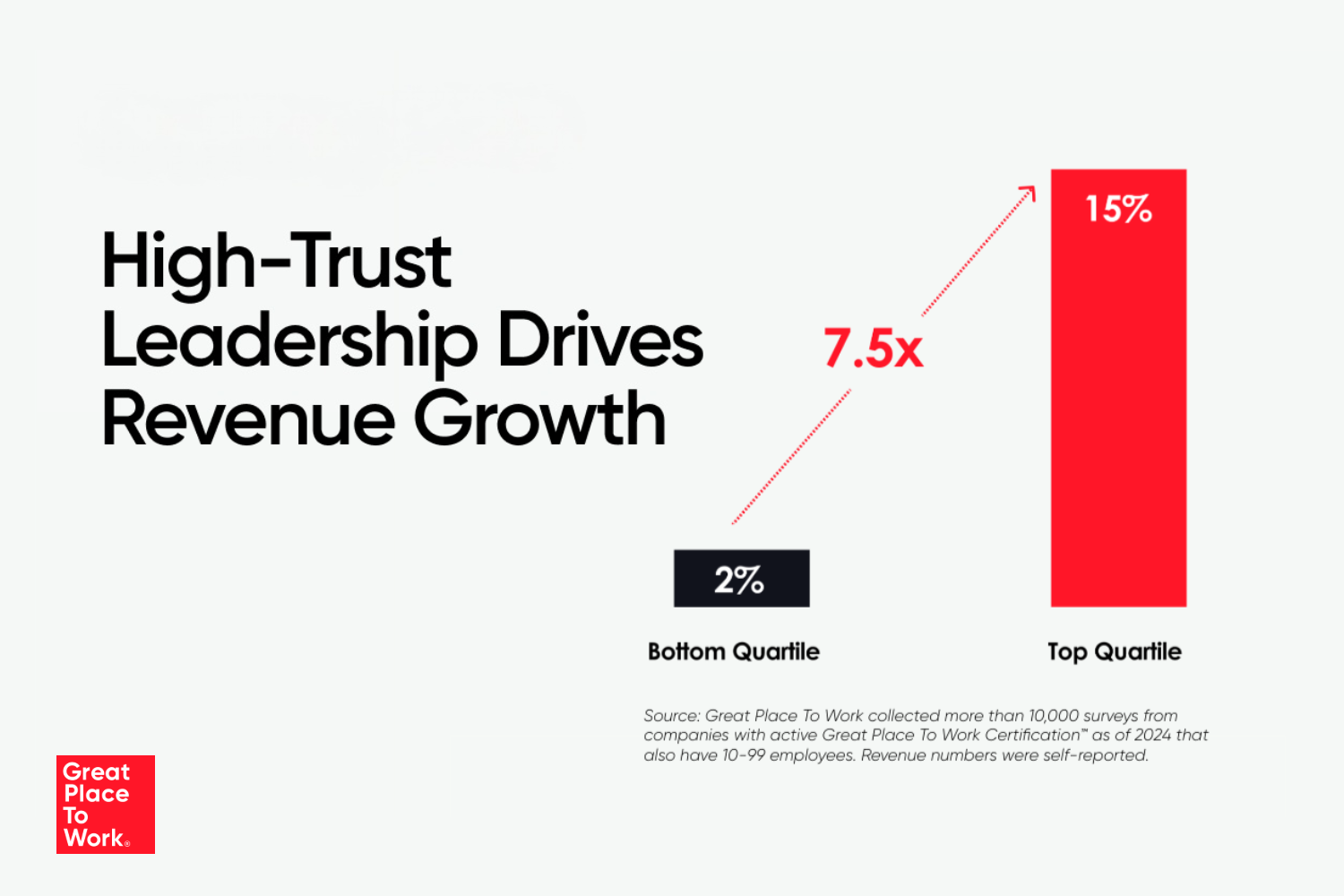
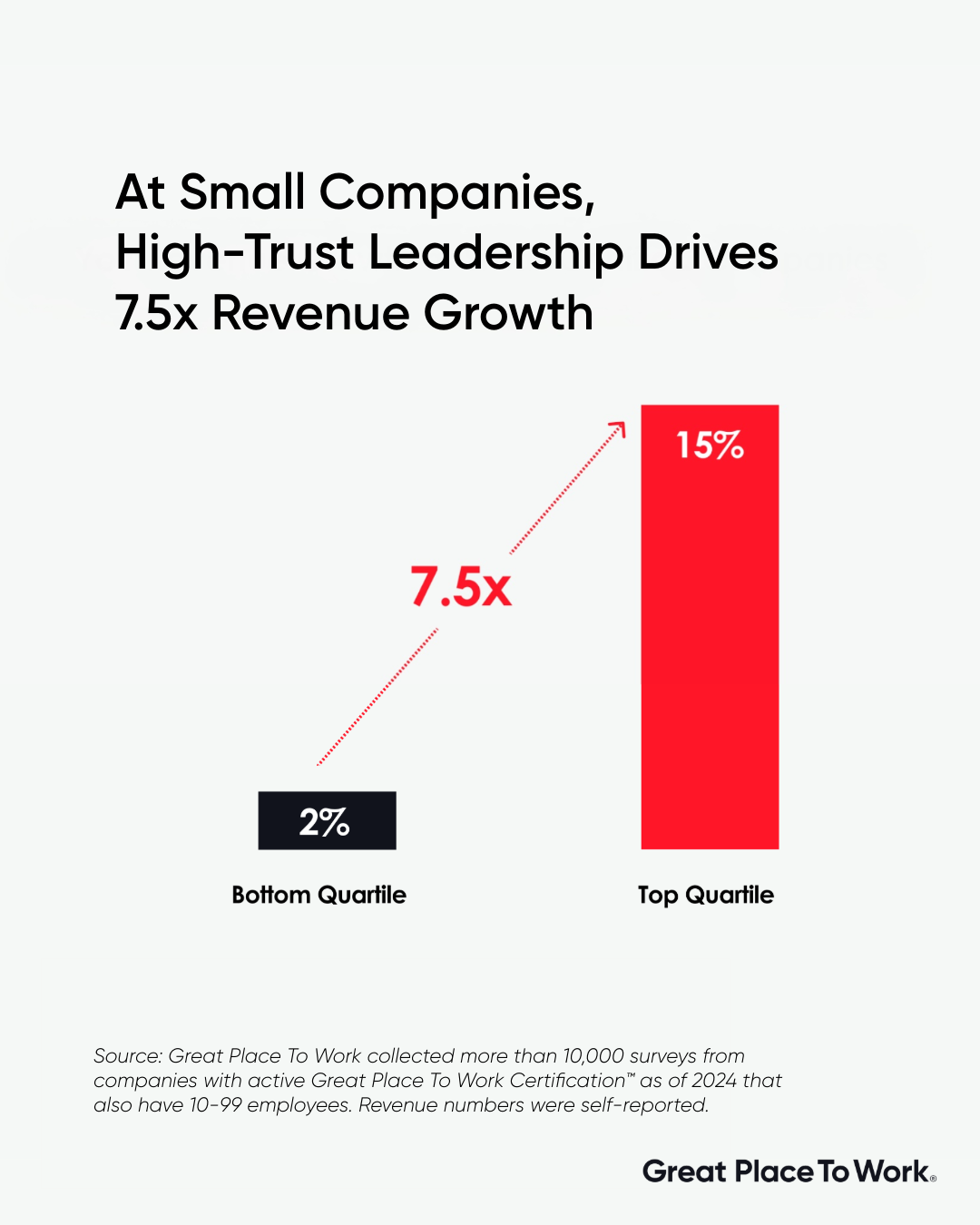
Great Place To Work measures leadership effectiveness as part of its 60-question proprietary Trust Index™ Survey. For small companies (10 to 99 employees) in the top quartile of leadership scores, revenue grows 7.5 times faster than at companies in the bottom quartile, per a Great Place To Work survey of more than 10,000 employees at more than 250 companies.
That’s the difference between double-digit growth at 15% year-over-year and flatlining growth at just 2%.
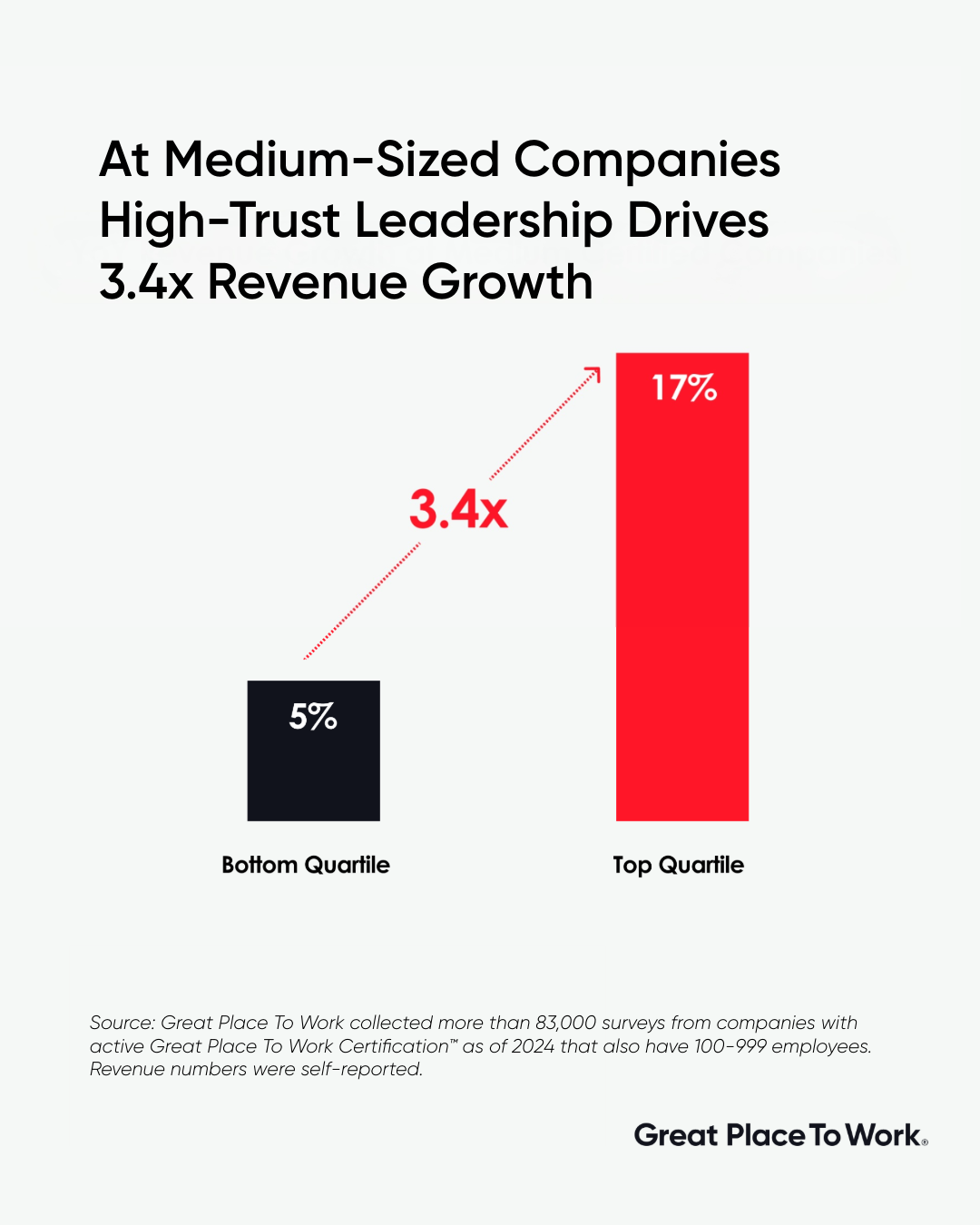
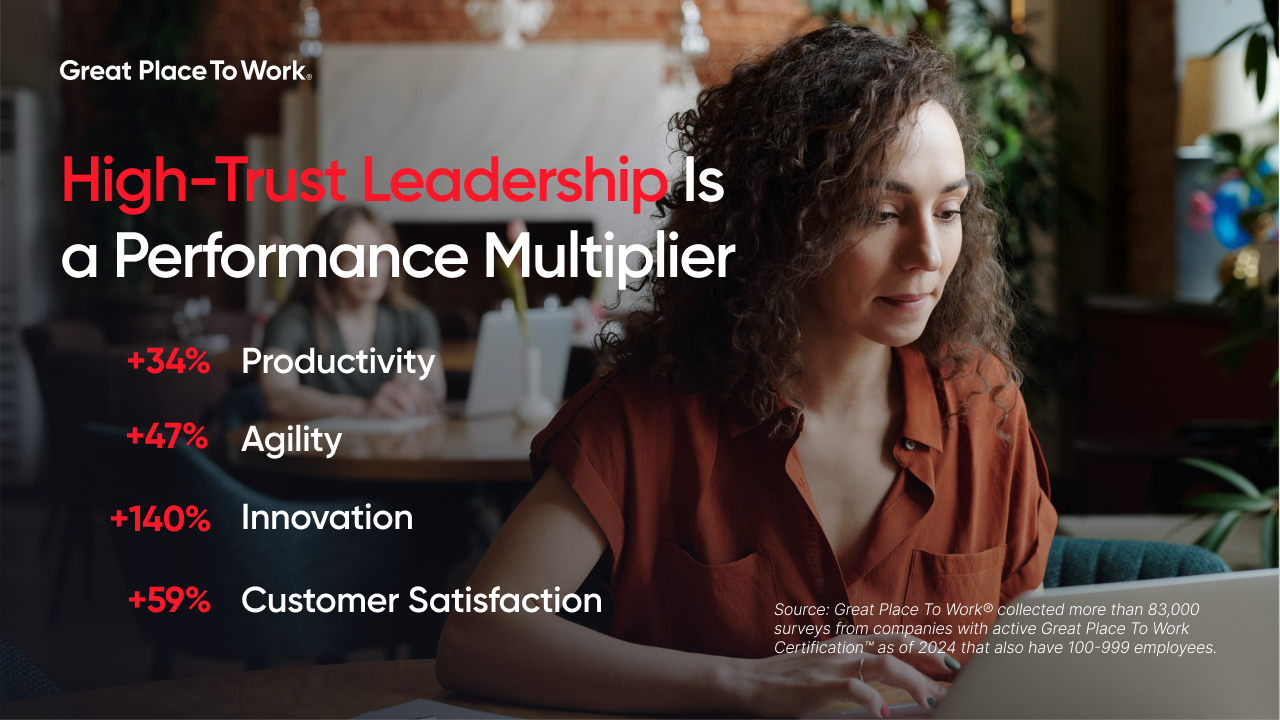
Even for slightly larger “medium-sized” companies with 100 to 999 employees, the impact of higher leadership scores correlates to 3.4 times more revenue growth, per a Great Place To Work survey of more than 83,000 employees at nearly 400 companies.
SMBs have different priorities
At companies with fewer than 1,000 employees, leadership makes a huge difference. Leaders can rally people to meet tight deadlines, quickly pivot from a failing strategy or launch new products to deliver the revenue that smaller businesses desperately need. In these smaller organizations, one leader has a much bigger impact than they might at a larger company.
“There are fewer buffers between top leadership and people on the front line,” explains Krittika Deshwal, principal business data analyst at Great Place To Work. “As a result, leadership scores on surveys have a stronger correlation to business performance.”
The leadership opportunity
High-performance workplace culture starts with leadership, and the trust that is built through the nine high-trust leadership behaviors.
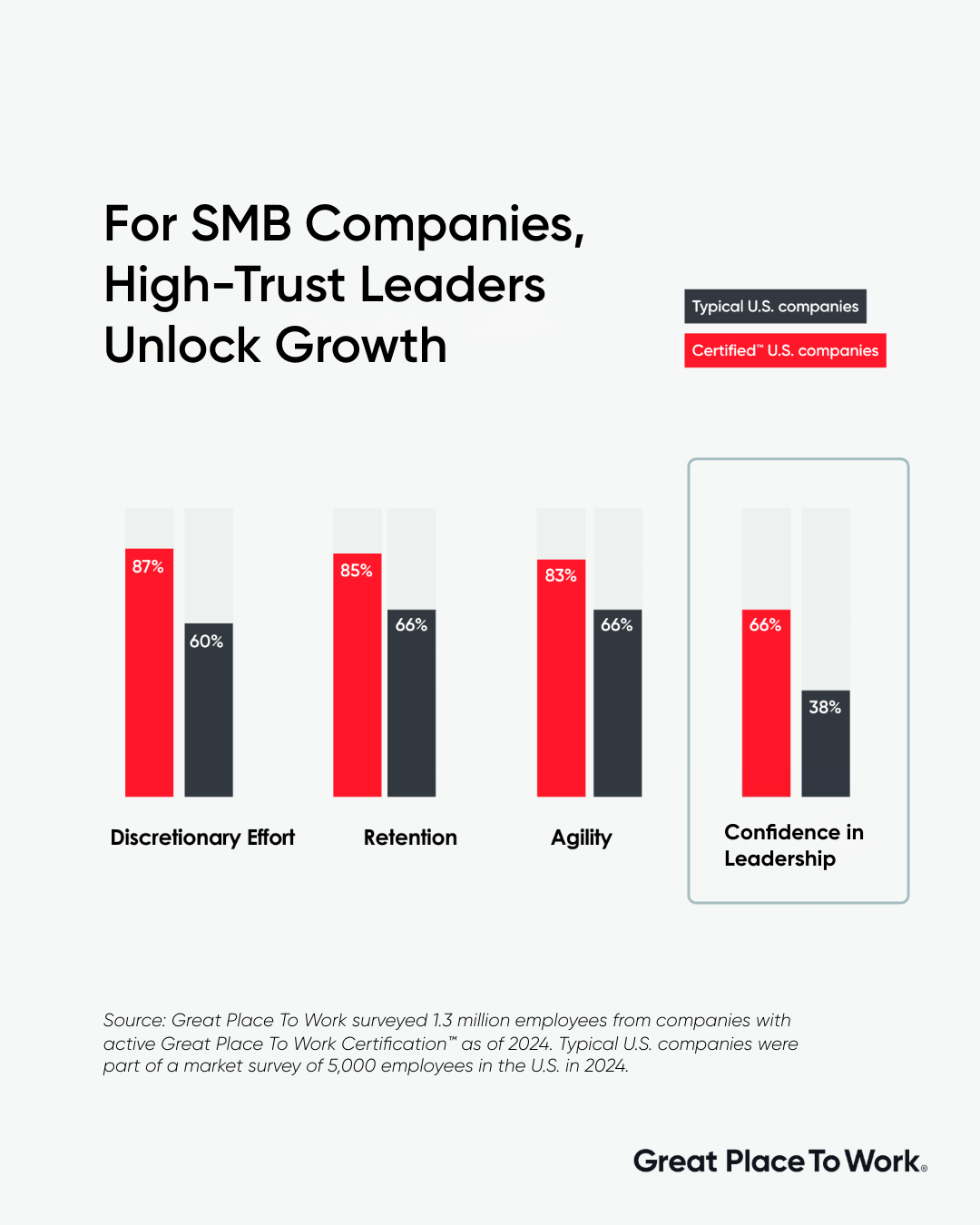
Great Place To Work Certified™ companies report higher confidence in their leaders — 66% versus 38% at typical workplaces, an increase of 74%. That leadership gap helps explain their outperformance on measures of productivity, agility, and retention.
“Because our model is interconnected, measuring confidence in leadership gives us a clear signal on performance across the organization,” explains Deshwal. “Using odds ratios, we can see how leadership drives a range of important outcomes.”
The outsized revenue growth enjoyed by the top quartile of companies is due to consistent improvement on the survey, Deshwal says.
“Companies that intentionally invest in leadership are growing their revenue much faster than their peers, which means measuring leadership effectiveness is key for survival as a small or medium business.”
Leadership practices that drive results
What should leaders at small and medium-sized businesses do to capitalize on the value of high-trust leadership?
Start with access and connection, says Julian Lute, insights and innovation strategist at Great Place To Work.
“Employees in small companies watch leaders closely and are constantly assessing their direct relationship with decision-makers,” he adds. “If you feel your leaders are approachable, friendly, and invested in your success, that makes an even bigger difference in those workplaces built on personal relationships.”
The value of leadership also demands investment in leadership, even for early-stage businesses. “Onboard leaders with clear expectations and give them regular space to practice leadership, not just chase goals,” Lute says.
To get everyone comfortable with accountability, Lute recommends that leaders practice going first in owning mistakes. “On smaller teams, wins naturally feel collective, but losses often get assigned to one person,” he says. “That dynamic kills trust and discourages people from taking risks.”
The risk for any leader is trying to change too many things at once. Small companies fighting for their survival might feel they don’t have the luxury to focus on only one problem at a time. However, cultural change requires consistency and repetition, both of which benefit from a clear and simple objective.
“Pick one behavior to improve right away, such as clarifying decisions, slowing down to listen, or closing communication loops,” Lute recommends. “Tell your team what you are working on and show the change in action.”
Join us
Learn how Great Place To Work can help you grow your business at the Executive Leadership Experience in Las Vegas, April 21-23.
Find your community
Connect with seasoned pros at top workplaces during our For All Summit™. Dive into the premier workplace culture conference in the country.