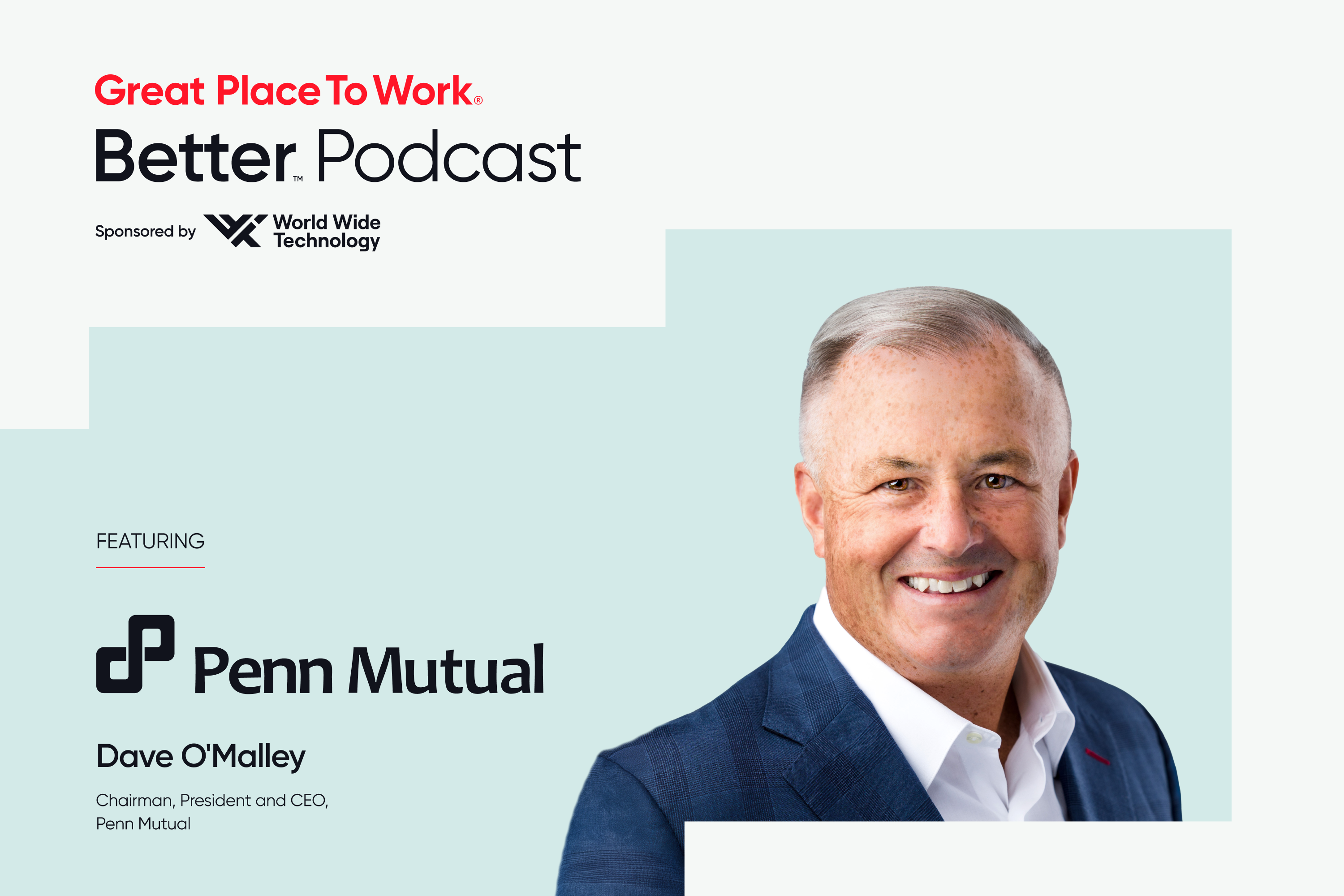


Dave O'Malley rose from a 19-year-old intern to CEO of Penn Mutual. In this episode of the Better podcast, he shares why trust is a business strategy, how workplace flexibility helps employees do their best work, and why fairness has to show up in everyday decisions, not just company policies. He also reflects on the mentors who shaped his career, the opportunities that changed his path, and what leaders get wrong about influence and authority.
Key takeaways
1. Great leaders rely on influence, not authority.
The best decisions come from bringing people along and considering different perspectives, not from exercising power.
2. Flexibility means much more than remote work.
The company's philosophy is simple: meet people where they are. Whether employees are caring for children, aging parents, pets, or managing other responsibilities, leaders trust employees to get their work done while accommodating real-life needs. That trust has fueled engagement, retention, and recruiting success.
3. Fairness isn't a policy. It's a thousand small decisions.
Fairness starts with company-wide priorities like transparent compensation, shared bonus programs, and equal access to opportunities. But the real work happens in the everyday decisions leaders make about who gets opportunities, who gets support, and how people are treated.
4. Psychological safety is a business advantage.
Great leaders create environments where people feel safe raising concerns, challenging assumptions, and pointing out problems before they become crises.
O'Malley believes someone in the organization always knows what's going wrong before leadership does. The key is creating a culture where employees feel comfortable speaking up.
5. Careers are built by saying yes to opportunities.
From a 19-year-old intern to CEO, O'Malley's career was shaped by taking on uncomfortable challenges and taking advantage of opportunities before he felt fully ready. His advice: trust your instincts, lean into change, and don't let fear of the unknown hold you back.
[00:00:00] Roula Amire: Welcome to Better by Great Place To Work, the global authority on workplace culture. I'm your host, Roula Amire, content director at Great Place To Work.
[00:00:16] He started at Penn Mutual at 19 years old as a college intern. Today, he's the CEO. I'm talking about my guest, David O'Malley, and his story is a masterclass in what happens when you seize opportunities and invest in people along the way. What I found so refreshing was how we talked about workplace flexibility, what it means, why it matters, and why parents and caregivers are some of their most engaged employees.
[00:00:44] Why it's so important to meet your people where they are, and when you do, why that brings out the best in them. We also talked about building a culture of fairness, why he's created an environment where people feel safe to disagree and speak up and speak out. So if you're looking to hear from a leader who's built trust, has created an environment where it truly is people first and that drives the success of their business, this episode is for you.
[00:01:12] Enjoy Well, Dave, welcome to the podcast.
[00:01:17] David O'Malley: Thank you. It's great to be here.
[00:01:18] Roula Amire: It's great to have you on. as I was prepping for today, your career really stood out to me. You started at Penn Mutual as an intern at age 19, and 30 years later, you're the CEO. That is quite a remarkable story. Looking back, is there a moment or experience that has stuck with you, that's shaped how you lead, a hard moment, a hard conversation, or an experience you had?
[00:01:46] David O'Malley: Yeah. It's, it's been a wild journey, right, to say the least, from starting as an intern in the investment area to seeing quite a few of the different management roles, and it's now been 20 years on the executive management team. And, you know, when I think about, like, what is that one experience? I don't think there was just one.
[00:02:01] I think it was a culmination of experiences, that really all lead back to one thing, which was kinda leaning into taking opportunities. Taking those risks. When things were presented to me, even if they didn't feel comfortable, it was taking advantage of them, and trying to figure it out- and figure out how to bring people along, and a lot of it was around change. How should we change as an organization? How is the world around us changing? And how do we lead through change? And so I think I've tried to build on that throughout the course of my career. But so not one pivotal, like, sort of aha moment- but there is a theme that definitely rhymes throughout the course of my career.
[00:02:36] Roula Amire: So you said yes even when in your mind you thought, "No. What? Can I do this?" You just went for it.
[00:02:43] David O'Malley: Absolutely. And I could- Yeah ... think my first executive job was our first chief risk officer-
[00:02:47] Roula Amire: Okay ...
[00:02:48] David O'Malley: in 2006. And I had gone pretty much every area of the investment area.
[00:02:52] I'd done a lot of coordination across our asset and liability side of the balance sheet. And I was given a job where basically I was to be removed from all those things that sort of I had identified as really good at.
[00:03:04] And then looking at the big picture and left- having to leverage sort of the relationships that I have to make decisions better throughout the organization.
[00:03:13] And it was a really scary thing. It was really uncomfortable, but I think it really did also transform and shape how I think about change today.
[00:03:20] Roula Amire: Yeah. When you started as an intern at 19, did you think, "Oh, I'm gonna... I wanna work here. This is amazing. I'm gonna... I wanna work here my, my entire career"?
[00:03:35] or what... Was it the opportunities that kept you there? Was it the culture?
[00:03:38] David O'Malley: Yeah. I, I, I answered this question to our HR leadership team, quite a few years ago. And it was at that point where I was about 20 years with the company, and I had had 14 different jobs. 14 different titles during my 20 years with the company.
[00:03:53] Yeah. And so change was the constant.
[00:03:56] Roula Amire: Right.
[00:03:57] David O'Malley: And leaning into that. And I think leaders today really need to embrace that and lead to sort of say, "Okay. We learned a tremendous amount from the past. We can look at how those things either worked really well, what, what decisions we made." And they, but they only inform the future.
[00:04:12] They only help us inform that. And I think that change is that constant, and being able to lead and, and help people through change- ... which is necessary, is there. So to me, it's been the opportunities. the company is a mid-sized company. It's not a huge behemoth, right? There's not a tremendous amount of bureaucracy.
[00:04:28] Never really has been. And I think that opens up an environment where you can really seize that opportunity. You can see, I think we try and be very transparent about our business goals and what we're trying to accomplish, and it really gives people the opportunity to lean into that change.
[00:04:41] Roula Amire: Thanks for sharing.
[00:04:42] Most of us learn a lot in our first job, but don't go on to lead the company where we started our career. one more leadership question before we move on. I heard you talk about authority being one of the least effective leadership skills and influence being one of the most powerful. How did you come to believe that?
[00:05:02] David O'Malley: Well, and it really comes from that experience, that first experience. I had a lot of authority to transact billions of dollars in securities. But then I went into a role where really I had to influence people to make their decisions better, to help them see a broader perspective. I had authority to do nothing in that chief risk officer job.
[00:05:19] I had to utilize influence, and what I realized was that influence could be a much more powerful tool. So the role I sit in today, obviously at the top of the organization, I have the ultimate authority. But I try never to use it Because I think that if I can help influence decisions, the buy-in's better, the people feel better about the decisions, they understand it better 'cause it's not just one person talking about it.
[00:05:45] That influence really has a trickle-down impact on our people, on our culture, and really allows for pivots and differences of opinion to come out, and to be able to leverage that. So I view that influence as absolutely critical.
[00:06:00] Roula Amire: I wanna make sure we talk about what you call flexibility for all, because it goes way beyond remote, remote work.
[00:06:07] At Penn Mutual, people can shape their workdays around their lives and still grow their careers, so you don't have to choose between one or the other. What really caught my attention was caregivers are your most... are some of your most engaged employees, which is definitely not the norm. almost 90% of parents say Penn Mutual is a psychologically and emotionally healthy place to work, and 88% of employees who are part of the sandwich generation, so they're caring for older parents or adults, as well as younger children, say the same thing, that it is an emotionally healthy and work place to work.
[00:06:43] So to start, why does flexibility matter so much to you personally?
[00:06:49] David O'Malley: Yeah, so it's interesting how we got to this point, and maybe I'll take a little bit of a detour- Sure ... quickly to get there. When I think of most of my time at the company up into the pandemic, we were a single-site company. We worked out of one building with 80% of our people coming into the office every day.
[00:07:05] Pandemic hit, and we had prepared well for kind of that, event of going home, and so we, we did that, and it worked well. I think as we looked at this, and as worked with, with our CHRO, who I'd just brought into the organization at the time, we realized that our employees were telling us one thing: "Please meet us where we're at."
[00:07:24] And so that's kind of been the mantra for whether or not it's the caregiver leave program, or it's how we look at,building our job programs. It's meeting people with where they're at, and I think that has really shown great value, not only in terms of retention, but also of attracting people to the organization and their commitment to their job.
[00:07:41] Because they know that that's something that is unique, and they feel that we're able to, you know, modify the workday, modify their work processes to meet them with where they're at. And that really, that flexibility has allowed us to do some incredible things from a people and culture perspective.
[00:07:57] And I think that's why you're seeing those numbers, because I think people do feel that, their unique situations, whether or not it's childcare, elder care, pet care, right? you know, all of those things are, if we meet people with where they're at, they view that their employment experience is much more rewarding to them.
[00:08:13] Roula Amire: So what I'm hearing is it started during the pandemic, and it's just grown From there, in terms of flexible work, things that come up in your life that are- Yeah ... part of your world, they don't have... It doesn't just exist outside the workplace doors. So if you have to pick up a child, or take a pet, or what have you, it's...
[00:08:33] People at Penn Mutual aren't afraid to tell their bosses, "I gotta go."
[00:08:37] David O'Malley: I gotta go and I have to do this.
[00:08:38] Roula Amire: Yeah,
[00:08:38] yeah.
[00:08:39] David O'Malley: I, I thought we were flexible before.
[00:08:41] But what we really, I think, saw was we flipped that 80% to we're less than 1% of the work in the, in an office every day today. And I think all of our people know that that's part of what makes us special.
[00:08:54] Everybody knows what their job is, how much work they need to get done, what they need to do, and then I think having a high-trust culture, especially with- within leadership and with the employee population broadly. You know, when you have that, you can then engage in those conversations that are very real.
[00:09:12] And when you meet people with where they're at, I think they bring their best, and, it's amazing what happens when you bring out the best in people.
[00:09:18] Roula Amire: Yeah. It's that virtuous cycle of care.
[00:09:21] David O'Malley: It
[00:09:21] Roula Amire: is. If you care for me, I'll care for you. If you work hard for me, I'll work hard for you. If y- you know. I- We see that in high-trust workplaces, and that's exactly what you're describing.
[00:09:30] They're, they trust their leaders, they trust their, their coworkers and managers. It's a high-trust workplace, so they feel they can have vulnerable conversation. Yeah. They're not afraid of consequence or politicking or things like that.
[00:09:43] David O'Malley: Yeah. And they can be authentic to who they are and what is going on in their life, and they don't have to come and put up a facade because they think that there's a certain way that things must be done and that leadership won't accept that.
[00:09:52] And I think that we have created a high-trust environment. and it is a virtuous cycle, as you said.
[00:09:57] Roula Amire: Support for wellbeing and caregiving is one of the first things that leaders cut, but as we've talked about, your, your scores are not only really good, they're significantly higher than what we typically see in your industry.
[00:10:10] Why isn't this just a nice-to-have? Why is it a real business Decision.
[00:10:17] David O'Malley: Yeah, 'cause I think that when we- we've differentiated our employment proposition broadly in the industry that we're in, right? Which has gone more, probably more in-office, has probably struggled a little bit more with,the, the hybrid environment that may not be as real as the hybrid- words themselves. And I think that, that, that then you have to say, "Okay, well, what do we need to invest in if we're gonna have a flexible workforce?" And I think there is that human connection, and so that brings in the wellbeing and the tools that we've added to make sure that we have the resources for people to, to work outside, work with, top-tier vendors to be able to provide wellbeing, and meeting them, again, back where they're at.
[00:10:56] And so, having that sort of healthy mental health, wellbeing environment, I think is, is part of what, what, what really needs to be. If it's psychologically safe, high trust that we've talked about-
[00:11:08] Roula Amire: ...
[00:11:08] David O'Malley: that's an environment that people want to be part of.
[00:11:11] Roula Amire: And that shows up in the bottom line, because it drives your- business performance.
[00:11:16] You know, leaders say they want their employees to be... What do they want? They want them to be agile, innovative, productive. They want them to stay at their company. They want them to use AI. I mean, every business leader wants that out of their people. But I think what's missed, unlike Penn Mutual or a high-trust company, is how you get that.
[00:11:36] You know, how you create the environment where you get those business results.
[00:11:40] David O'Malley: A-absolutely, and I think in our, in our environment where we have the, the fact that our customer is the financial professional, who then recommends our product and service to the end client- ... our policy holder, who we're in business to deliver for.
[00:11:55] So there's that key piece of that relationship that is there, and I think w- the more that we're able to lean into that relationship, the more that we're able to foster that connection, the results end up trickling down in a very, very positive way to all of our stakeholder groups, but especially to our policy holders as the owners of the company, because I think they know that we're there with a company that has their own best wellbeing, their own- interests at heart. And they feel that from our employees.
[00:12:23] Roula Amire: So, like wellbeing, fairness is something many companies say matters, but employees often experience something very different, especially when it comes to pay, promotions, pr- fair share of profits, things like that. Penn Mutual employees are 71% more likely than peers in your industry to say their managers don't play favorites, which is a remarkable number.
[00:12:47] That's, that's giant. So what does fairness look like in, in practice, especially when these decisions can feel personal, can feel subjective? What are leaders doing day to day that show employees that these decisions are fair?
[00:13:05] David O'Malley: Yeah. I, I think it has to start with that if fairness is something that you want, you have to be able to sort of say, "This is something we're trying to ac- accomplish."
[00:13:13] That... And putting that out there for everybody to see, and to also be able to say, "Well, was this fair?" "Was this not?" Then I think you have to start looking at how does the company operate at, at the highest level, and sort of say, with like our bonus program. Every one of our employees is open to the bonus program.
[00:13:31] Doesn't matter what role you have, you know what the metrics are, you're all part of that same program. To me, that's fair.
[00:13:38] Having pay transparency with our jobs, having those opportunities around career path and progression and being able to step into those things is about fairness. Being able to have, our benefits in a way that are fair.
[00:13:52] again, that, that everyone is sort of having the same opportunity. And so I think you can create that fairness at the very top corporate level with our programs. And then there's those micro decisions, right? And I think those are probably the most important ones- ... at the end of the day that start to get into it.
[00:14:08] And it's, so how are people selected for teams? How are people selected for opportunities? And I do think as we've met people with where they're at, we don't have different systems. We don't have people who have special deals around flexibility, if we go back to that one. And we don't have people with special deals around how do they, you know, work their day.
[00:14:28] Everybody knows that they're able to, to drive that, and it's perceived as fair. We also open up all of our opportunities globally, whether or not it's around our charitable opportunities, our opportunities to get involved in programs, and people see that. It's not that there's a select group of employees that are picked for this.
[00:14:47] We go out and solicit who has a passion about this, and we wanna accept everybody who's looking for that. And I think they see that as fair and open. But it's the micro decisions, and,as we know, all leadership is local at the end of the day. But I think the more you talk about it, the more you're able to desi- design consistent practices across the subgroups within the company.
[00:15:08] And so it's something we talk about, something we talk about openly, 'cause I think that's part of, getting to, to fairness, is being able to say, "Okay, we need to be able to, to lean into this and talk about maybe where people don't perceive it as fair. Why was it done that way, and should we be making changes?"
[00:15:23] Roula Amire: So the first thing you said was set it as a goal, have fairness be something you actually want to achieve.
[00:15:30] I think that's a great takeaway. and then the second thing I heard is the micro decisions, you know, that, tho- those micro actions, so you can have the broader policy. Shed some color on that.
[00:15:42] What might be... So you've been in, you know, you've been here for 30 years. Yeah. You've had different leadership positions. You've been under leaders. You, so you, you know how it goes. You know? You've, you've worked way up. What are some of those micro decisions around fairness that might not get seen, but that go a long way?
[00:16:00] David O'Malley: Yeah, so I think it's around, right, th- a lot of times when things don't go right, it's personality conflicts. It's style around personality. It's leaning into sort of how do we all process information? How do we engage? We need, a lot of different perspectives. We wanna make sure that we're, that we're able to do this, and so how do we engage in that type of conversation, and how do we make sure that we're executing to that?
[00:16:24] And I think our, HR team, with the business partners does a tremendous job of working at the department levels of making sure that leaders are leaning into that. I think the training and development that we bring to them, I think talking about things openly- is, is very important to really assessing that.
[00:16:39] And then it is, you know, people will emulate what you expect, and so they're gonna watch their leaders, and if their leaders aren't doing it, they're gonna follow what they're, what we wouldn't want. And so how do we- ... make sure that we hold accountable to the behaviors that we expect as a company?
[00:16:53] 'Cause at the end of the day, it's those behaviors that will shape culture.
[00:17:02] Roula Amire: AI is reshaping jobs, teams, and leadership faster than most organizations are ready for. From strategy to security to adoption, the AI Proving Ground podcast presented by World Wide Technology is a grounded look at what responsible AI leadership really requires in this era of rapid change. Find it now wherever you get your podcasts.
[00:17:33] From what I can tell, you've spent most of your life in Pennsylvania What do you love about where you're from?
[00:17:41] David O'Malley: So it has to be the sports. so as, growing up and spending most of my life in, in Pennsylvania, obviously a huge Philadelphia sports fan. And, I think we have, you know, the best fans around, and the passion for our sports teams.
[00:17:55] Now, it was a long dry period, ... for at certain points, but that's turned a little bit for, some of our teams. But, for me, the connection to, to, to the sports and the engagement around, around our sports franchises is, is, is one of the unique things about Philadelphia. You know, there's, there's a sort of scrappiness about Philadelphia-
[00:18:12] that I think that, that we as a company embrace. right? There's some very big, well-known brands that do a lot of advertising, and we're not gonna make an impact that way. So how do we differentiate ourselves? How do we... You know, one of the strategic things that I look at is basically how, what are we willing to do that our competitors are not, that meet our mission and goals, right?
[00:18:33] So in investing, great example of that is our investments in top-tier service. We have spectacular people, and we-- but we've also added incredible tools to be able to invest in service when our industry is cutting back. And the experiences in there, well, to me, that's s- that's scrappy. That's saying, "Okay, if we're not gonna win on, advertising on golf or on some other sports, how do we dif- differentiate ourselves?
[00:18:56] And is that something we can do and be authentic to what our mission is?" And, I think that's, that's, that's, that's one of our current ones that is really separating us in the industry, is being able to deliver incredible service to all of our stakeholders, where our industry may be falling down on that.
[00:19:12] Roula Amire: Is that a s- a quote, "soft skill" you'd look at in a potential hire if... I mean, I don't know how you'd evaluate scrappiness. But- ... someone who's maybe innovative or creative or has done something in the past, you might see, like, "Oh, that, that's gonna be a fit here."
[00:19:27] David O'Malley: Yeah. I, I was having a conversation yesterday, actually with a, potential senior hire.
[00:19:32] And, the conversation really was, they asked me the question, "What's the, what is one of those differentiators that people should know before they would take a senior job- ... at Penn Mutual?" And if you're not a player coach, if you're not willing to get your uniform dirty, we're probably not the right culture for you.
[00:19:49] And that doesn't mean that's wrong for every- But I think being honest- ... about that and saying, "Okay, you're gonna have to come and be, be scrappy. You're gonna have to get the, the uniform a bit dirty because we need..." I still bring areas of expertise to the company, probably not like the typical CEO, because that's what a, a mid-sized company that's growing faster than the industry needs.
[00:20:11] We need to be able to tap into our expertise. and it works well. So I think that is a conversation from yesterday, literally about, what it, what's, what's a differentiator. In some companies, you're not gonna see that. You're not gonna see that type of level of, of maybe Hands-onness that, that's there.
[00:20:27] But I also think it helps him build great relationships and has everybody else, the rest of the employees, see that no one's not willing to do the job that I'm asked to do.
[00:20:37] Roula Amire: Well, and that speaks to fairness.
[00:20:38] David O'Malley: It does.
[00:20:39] Roula Amire: It's- No one's above anyone here.
[00:20:41] David O'Malley: Yeah. And w- always willing to kinda go in and step in and, help out and, and understand.
[00:20:47] And I think that,our leaders do that. They demonstrate that. And the ones that have been the most successful over time are the ones that are saying, "Okay. I wanna understand exactly what you're doing, how you're, how you're, how you're feeling, what is, what's working, what's not, and then what can we do different and how do we do that together?"
[00:21:03] Roula Amire: What is some advice you'd go back and give your younger self? Y-
[00:21:07] David O'Malley: you know, it's interesting. when, when I think about that, it's, I, I've leaned into a lot of change. But when I look back over my career, probably it's even to trust my instincts more.
[00:21:18] Roula Amire: Okay.
[00:21:19] David O'Malley: And to sorta say that you know that as, when you do things that are challenging or unpopular ch- or impacting the status quo, that it's maybe not gonna be perceived well by everybody.
[00:21:30] But to trust it and go for it. Because when and you have the right people and the right direction, don't worry about the rest of the noise. Just kinda forge through it and, and, and execute to that, to that vision.
[00:21:41] Roula Amire: Yeah. Keep your vision.
[00:21:43] David O'Malley: Yeah.
[00:21:43] Roula Amire: You know, but most people, how most people answer that question is how you've navigated your career, which is they say, "I wish I took more risks," you know, went for, went for opportunities, which you've done.
[00:21:55] David O'Malley: Yeah.
[00:21:55] Roula Amire: so...
[00:21:56] David O'Malley: Well, it's interesting. It even gets back to that first, first big job, 'cause I think the, probably the, if you say the honest knock on me- ... and in the m- on my climb up the management rank was was I too big a risk-taker? Because I ran the investment portfolio, and I was leaning into that, and I was pushing us into looking at derivatives and r- balance sheet management and those things that actually made us safer, but they felt riskier to others because they were not what we had done.
[00:22:23] And so when I got put in that first job of being chief risk officer, the goal wasn't to take... It was, it was, I can remember the CEO at the time, Bob Chappell. He was like, "Yeah, people think that, you, you, maybe you take too, on too much risk, so I'm gonna ask you to take a job where your job is to manage the risk."
[00:22:41] And so I think those are those interesting paradoxes along the way in a career, and I think we- you know, looking back, you can kinda see them. But, but, but that is... So, so I don't think it's about risk-taking, it's about decisiveness and making clear decisions with a vision towards the future and being willing to stick with it to execute through that.
[00:23:00] So I think- ... execution beats strategy every day. Consistent strategy with solid execution creates incredible results.
[00:23:08] Roula Amire: Even when at the time it might be an unpopular decision, to just keep it moving.
[00:23:14] David O'Malley: Yeah.
[00:23:14] Roula Amire: Yeah. And I th- If you have the vision ...
[00:23:15] David O'Malley: and I think about going flexible that way. There was more people who told us, "Don't do it."
[00:23:20] Roula Amire: Don't do it, yeah.
[00:23:21] David O'Malley: And it's been one of the best decisions we've ever made.
[00:23:25] Because I look at the talent that we're able to attract to the organization- ... and retain, and their commitment, and I would not question that decision again. But I know w- it was a lot of time put into it.
[00:23:34] There was a lot of thought put into it, and preparation. So you have to do those things. You can't just make a, a decision, but then execute to it. And I think, you know, one of the interesting things we did along that journey was we actually bulldozed our building and turned it into an open space.
[00:23:49] So there was no building to go back to. And so- You can't
[00:23:52] Roula Amire: reverse
[00:23:52] David O'Malley: that
[00:23:52] Roula Amire: decision ... you
[00:23:52] David O'Malley: can't reverse that decision. Yeah. And I think that's, that's one of those important things. How do you make those decisions and make them stick, and make them real?
[00:23:59] Roula Amire: Is there a book, podcast, or show that you love that you'd recommend, either now or just in general, that you, you might go back to?
[00:24:09] David O'Malley: I read so many things, but I, like, it's, it's, it's interesting. I don't necessarily have one. I think that, I try and, from a perspective of, of learning and continuously pushing kind of my thinking, I try and pull a lot of sources from off the run areas. Mm. Contrary thoughts to maybe my, my, my current thinking.
[00:24:30] So normally what I'm searching for is who maybe is taking the opposite narrative to the way that we're going, and sort of trying to see how do we test those things. So I don't necessarily have one for, for, for the audience, but I do think that there is, something in that,broader recommendation.
[00:24:46] Whether or not you're in the investment side, you can fall in love with sort of a view of the world and the market and what's going on- Mm ... in the news cycle that we all watch. How do you f- in business, how do you find the counter-narrative to the one? Because it's really easy, especially at the, the executive level, for everybody to tell you it's going great, and here's- Nod their head.
[00:25:05] If they're ha- ... and nod their head, and sh- Yeah ... "Oh, did you read this? It supports what we're doing." I think it's more about finding the thing that doesn't support what you're doing. Yes. Like questions and challenges so that you can have that, that intellectual debate.
[00:25:17] Roula Amire: Has... And does that make you rethink decisions or influence your own decisions?
[00:25:21] You talked about influence being, you know, such a strong leadership skill. I would imagine if you're well-versed in a subject, even the dissenting opinions, it helps you Talk to peo-, you know, talk in a, in a more constructive way.
[00:25:36] David O'Malley: A- absolutely. And how do you then create that in the environment of those that are working around you, right?
[00:25:41] To be able to say, "Maybe we're too consensus here." What is the, the kind of the counter, counter-consensus comment that needs to be made that we need to, to banter around about? how is somebody structuring that conversation? What data points are they using? And so, you know, I think as a leader, sometimes you have to be willing to say, "Okay, we've all kind of agreed on this, but there are risks.
[00:26:04] There are-" Right ... challenges. Well, maybe how do I make a debate that is pretty, you know, really cogent in thought that's on the other side of the argument so that we have to deal with that? And normally, it will do, I think, a couple things. It, a lot of times it confirms the direction you're going, and occasionally maybe you say, "Wow, you know what?
[00:26:24] We shouldn't." But I do think it makes a lot of course corrections. It really brings up some areas that, that may be,off the, the beaten path that you say, "Oh, you know what? We, we should consider this." Or, "Have we thought about how this impacts this area?"
[00:26:39] Roula Amire: Well, th- and this is what happens at a high trus- high-trust workplace.
[00:26:44] If you, the CEO, is, are, is asking for people who disagree- Mm ... who might not think this is the right path, and people feel safe enough to speak up, speak out, or not, or unprompted, not being asked. Yeah. Because you're looking for all sides, is what I'm hearing.
[00:27:01] David O'Malley: Absolutely.
[00:27:02] Roula Amire: Yeah. '
[00:27:02] David O'Malley: Cause I, s- if I go back to risk management, somebody always knows what's gonna go wr-wrong in the organization before leadership does.
[00:27:11] And if you can prompt people and create the environment where they are willing to talk about what's not working-
[00:27:16] Roula Amire: ...
[00:27:16] David O'Malley: that's gonna be your best risk management tool that you could ever put in place, because someone's seeing what's breaking. And we all know that not every organization is perfect. We're by no means the perfect organization.
[00:27:28] Mm. But I do believe the more that you can create a culture where your people want to speak up, where they want to say, and they know that they can do so from, from, from an environment where you're looking to only get better and stronger and make sure that you deliver on the mission of the company, then you can really have some great trust, some great engagement, and also deal with a lot of issues before they really happen.
[00:27:49] Roula Amire: That, that is the definition of psychological safety. Yeah. That's what you've... Yeah, that's what you've just described. To close, I am curious if, if you're willing to share, if there's a life-changing moment, that you've had. This could be a kind gesture, an interaction with someone, maybe a person or mentor, that either changed your path or that's just stayed with you over the years, personally or professionally.
[00:28:17] David O'Malley: So it's interesting. When I think of, like, the big break, right, and I think that most leaders have that, what was their big break? How did you get from this spot to the sort of acceleration? I go back to, I was,Penn Mutual about a little bit before I graduated, so I was still an intern.
[00:28:34] And the company made some choices around its mutual fund business, and it sold it off, but we kept a portion of, of, of funds.
[00:28:41] And m- one of my mentors and the CIO at the time, he came to me and said, "Look, I see what you've been doing, and I wanna give you this interesting opportunity. I'm gonna let you run this billion dollars at 20 years old, and I'm gonna be there to backstop you, and I'm gonna be there to do it, but you're gonna do it."
[00:29:02] And so I don't know that I would be here today doing the things that I've done if it wasn't that, you know, that, Peter took a chance on me all the way back then and said, "Hey, I'm gonna be there to backstop you, but do this." This is something that, you know, no 20-year-old probably should be respon-
[00:29:21] probably shouldn't even admit it on this podcast. but, but he, but he- Wow.
[00:29:24] Roula Amire: Talk about being seen. I mean, he- Yeah ... he saw something in you maybe you didn't even see in yourself. I mean, he trusted- Yeah ... he trusted you.
[00:29:30] David O'Malley: Yeah, and said, "Let's, let's, let's, you know, do this. Run this. This is something that where you can learn a ton, and, I wanna see what you're able to do."
[00:29:37] And, and then,from there kind of the rest is, a little bit of a, a long version of history with, ... some interesting market events along the way, including, kinda long-term capital management and the Asian financial crisis, and some interesting things for another longer discussion about the, about the, about the world and, and,investments.
[00:29:55] But- ... that one thing I, I think I go back to and I say, "If that wa- hadn't happened, what would my career have looked like?"
[00:30:03] Roula Amire: Yeah. What do you think is the answer?
[00:30:05] David O'Malley: Don't know. Yeah. I think it's so hard to say. Yeah. But if I look at a c- clear inflection point. Being given an opportunity.
[00:30:11] A- and the reality is r- I went to Drexel University, right?
[00:30:13] Great school.
[00:30:14] Co-op program, which is phenomenal. But a lot of the Wall Streeters are not coming from Drexel.
[00:30:20] Roula Amire: Right.
[00:30:21] David O'Malley: and at that time, that's what I had in mind. I wanted to, you know, I had that Wall Street kinda, kinda dream, and they weren't hiring from Drexel, per se. And so here's an opportunity that ultimately led me to running commercial real estate in securitized form, right?
[00:30:37] Led into long-term capital management at a hedge fund that collapsed. We did some amazing things, back then in taking on stuff, interesting derivative transactions, all kind of stepping th- across career. But I go back to, I don't know, that was kinda the, the, the escape velocity moment, you know? I ha- I think I had to seize upon that and do those things. But if that event hadn't happened, would I be where I'm at today? Don't know. But boy, it seemed like it was a really important event looking back 31 years ago now.
[00:31:08] Roula Amire: Yes. I would say that's- Yeah ... the most important- Yeah ... in, in your career- Yeah ... from, from what you've shared.
[00:31:15] Well, Dave, thank you for sharing. Thanks for the great tips and takeaways and the advice, and it was a pleasure to have you on.
[00:31:21] David O'Malley: This was such a pleasure. Thank you.
[00:31:23] Roula Amire: Thank you. Thanks for listening. If you enjoyed today's podcast, please leave a five-star rating, write a review, and subscribe so you don't miss an episode.
[00:31:34] You can stream this and previous episodes wherever podcasts are available.
Transform Your Workplace with Culture Insights from Top Experts.
Subscribe to our podcast and discover how to create a culture that attracts and retains top talent.