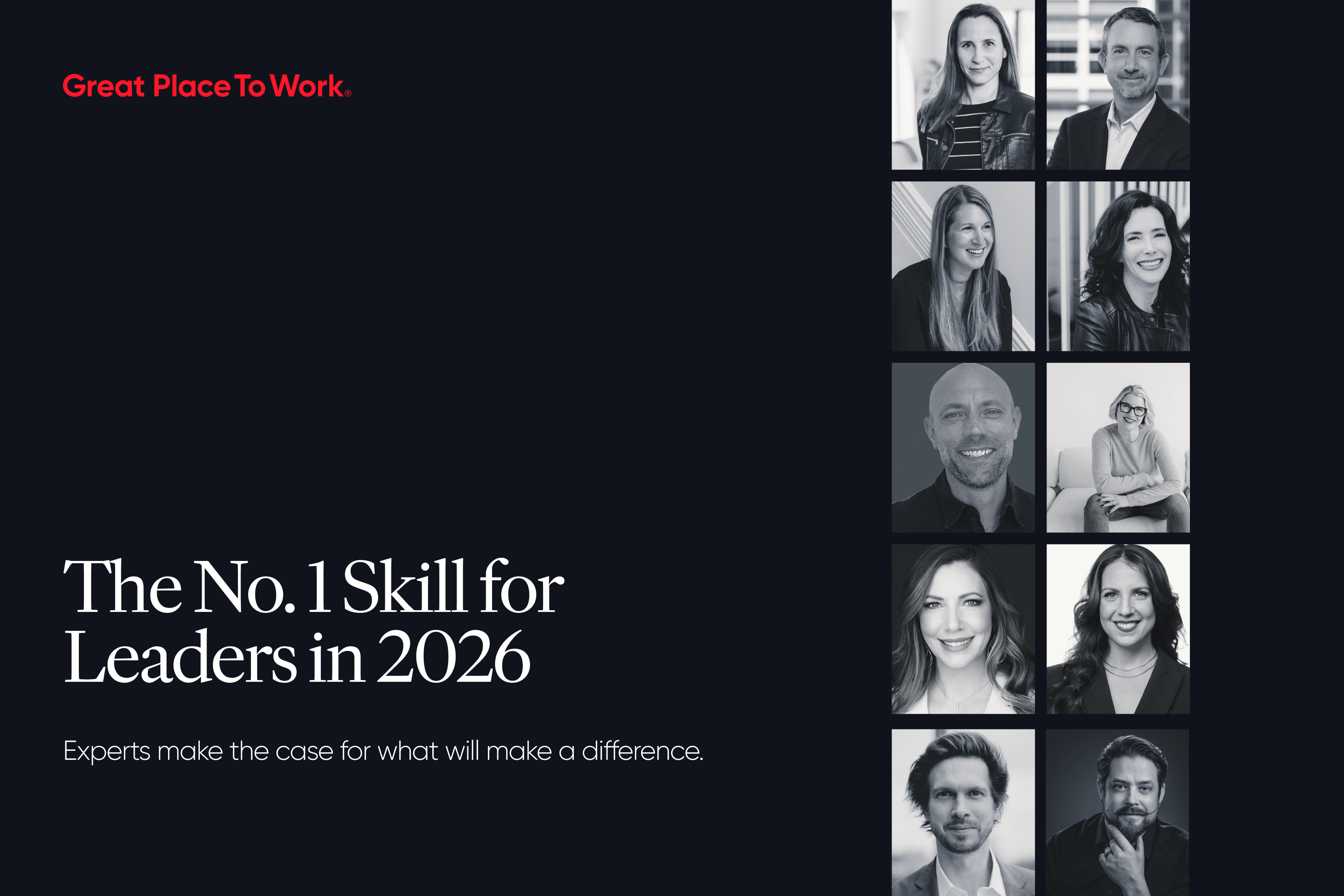




Here’s what the experts say is crucial to keep front and center in the year ahead.
Every business is focused on the impact of AI, and most experts see AI at the center of challenges facing the HR function in 2026.
Here’s how business and HR leaders can respond to the most disruptive forces in the workplace:
1. Determine how AI will impact every aspect of HR
“The biggest priorities for HR professionals in 2026 center around AI,” says Adam Mendler, UCLA professor and leadership expert. “Most leaders are extraordinarily excited about AI, and some are very scared about it, but everyone is thinking about it and, in turn, prioritizing the people and teams they lead to do the same.”
For HR, the first prudent step is to identify how AI will impact their operations directly. Savvy leaders will deepen relationships with technology and IT teams.
“The HR function is undergoing a major transformation,” says Sarah Lewis-Kulin, vice president of recognition and research at Great Place To Work®. “When CHROs and CTOs become strategic partners, they can co-lead cultural and business change, making people strategy inseparable from business growth.”
A second focus should be building trust with employees around AI systems.
“Employees are looking to HR to help guide them,” says Todd Cherches, professor at NYU and Columbia University and CEO of BigBlueGumball. HR needs to be ready to answer employees’ tough questions: “For example, if one employee with AI can do the job of ten employees, what are the implications?”
2. Get clear definitions for measuring the impact of AI
A reliable framework for measuring the success of AI projects is essential. MIT’s report that 95% of AI pilots were failing has shown a gap between the hype and the real-world impact of AI tools.
“There have been lots of big promises about the things that AI will do,” says Matt Bush, senior principal at Great Place To Work. “It’s time to start seeing if we’re going to make good on a lot of those things.”
Kelley Steven-Waiss, chief transformation officer at ServiceNow, has measurement at the top of her priorities for HR leaders in 2026, advising that the first step is “determining where to focus AI initiatives and how the value will be measured and created.”
The true exponential value of AI at work won’t be efficiency, according to leaders like Kelly Jones, chief people officer at Cisco.
“If you look at this only through the lens of, ‘How do we increase productivity of a company?’, the cost leaves the system one time,” Jones says. “It’s shortsighted.”
The more valuable change happens when employees can reallocate time savings to more meaningful work higher up the value chain in your business. “If you can give 5% of their time back to a more than 86,000-person enterprise, what they can do with that time to drive better outcomes for our customers is exponential.”
3. Focus on psychological safety to unlock AI transformation
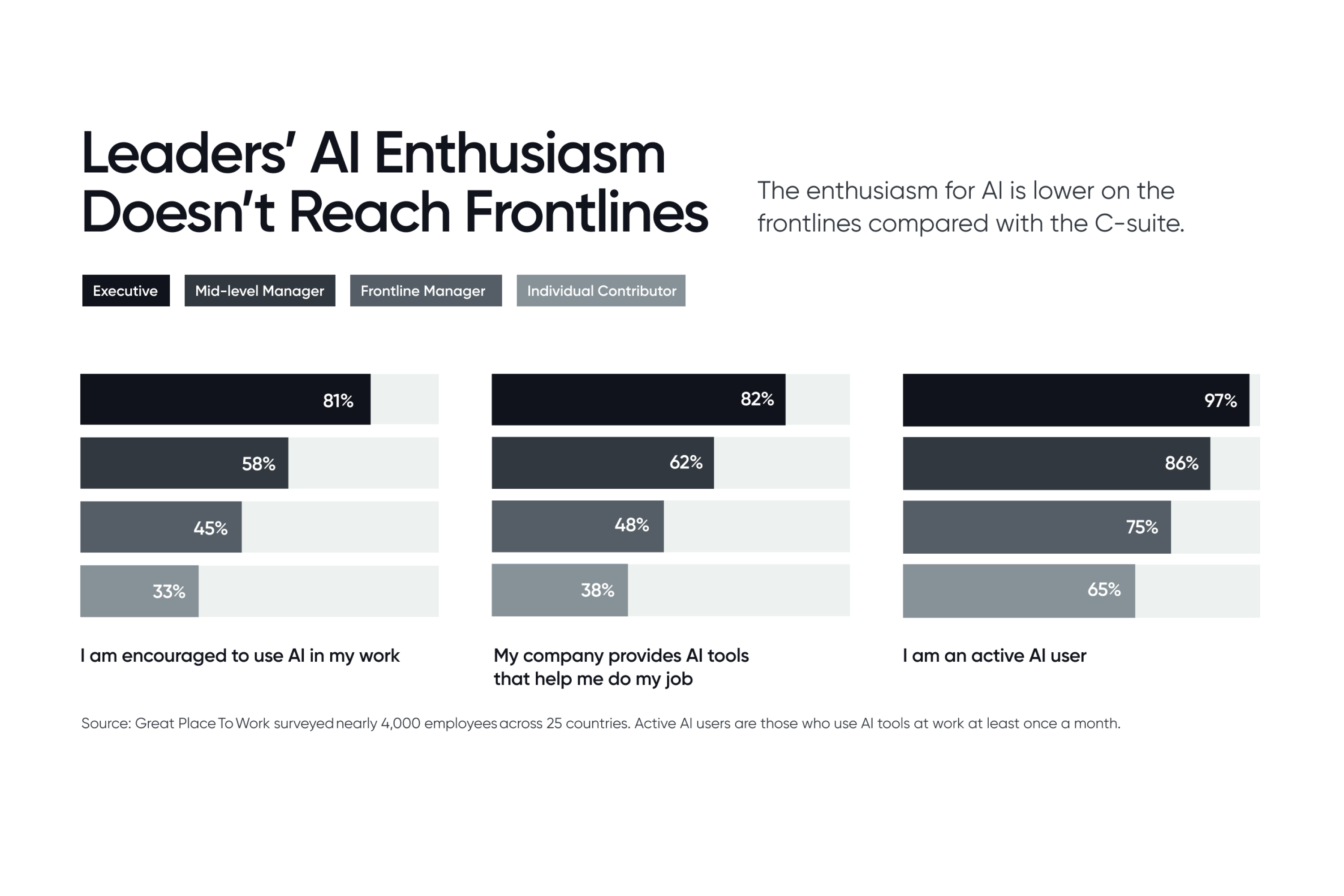
To understand why AI adoption and transformation are moving so slowly across organizations, the focus needs to shift from technology to people.
“As AI shifts from pilots to core enterprise infrastructure, the real differentiator won’t be the technology itself — it will be how well the C-suite builds trust, AI fluency, and feedback loops into their workforce,” says Lewis-Kulin. If employees don’t trust their leaders, AI rollouts will meet a stonewall of resistance.
High-trust workplaces enjoy higher levels of psychological safety, where employees feel more empowered and enthusiastic around AI innovation.
“Many companies focus solely on technical training but ignore the mental barriers that prevent employees from trusting new tools,” advises Gleb Tsipurksy, author and workplace consultant. “[Leaders must] build a culture where staff feel psychologically safe to rely on AI assistance without fearing that the technology will replace them.”
High levels of fear can lead employees to avoid the risks necessary to experiment and learn new ways of working.
“Leaders should focus on finding the right ways to continuously experiment and fail and learn all along the way,” says Marcus Erb, vice president of data science and innovation at Great Place To Work. Unfortunately, most business leaders don’t have the incentive to try new things that might fail — and that’s a barrier to AI progress.
4. Prepare for AI-driven burnout
“With this intense pace of change, and the laser focus on AI, how do we get the best out of our people?” says Mita Mallick, author of “The Devil Emails at Midnight: What Good Leaders Can Learn From Bad Bosses.”
The data suggests most companies are not getting the best from their people. Wiley Workplace Intelligence found in surveys from the past year that AI stress is having an impact:
- While 68% of employees were excited about AI’s potential, more than half of managers reported feeling unprepared to lead AI-driven change
- An overwhelming 95% of employees reported significant stress, with 36% describing it as severe, and nearly half of managers reported severe burnout
- Just 17% of workers landed in the “sweet spot” of high motivation and manageable stress
“The truth is, we can't get the best out of our people if they aren’t taking care of themselves,” Mallick says.
Instability is only likely to increase, warns Marcus Erb. With AI, a reorganization that might have taken longer will occur much faster. Chief executives might even ditch traditional C-suite models to align employees around a campaign or mission with AI co-pilots.
“The way we can organize and design a team is going to be able to change really rapidly,” Erb says. “I don't think people appreciate that yet.”
This will make restructuring work even more important in 2026.
“Most top performers do this: They have intense drive periods, and then they rest and recharge and recover,” Mallick says. “They hydrate, they get physical exercise, they eat well, and they find things that spark joy outside of work. Watch for more HR professionals and leaders to partner with companies like Wellhub, Calm, BetterUp Coaching, and more.”
5. Reinvigorate employee development and training programs
The most valuable response to AI disruption is an investment in training and development for employees. Yet, many companies are falling behind in the crucial bulwark of resilience for the organization.
“Senior leaders say that they want to see leadership at every level, but in these times of ever-increasing volatility, uncertainty, complexity, and ambiguity, they appear to be unable and/or unwilling to invest in the training and coaching of their people,” says Cherches.
Reimagining training is the answer to a number of problems: broken talent pipelines amid disappearing entry-level work, talent shortages in key technical areas, and overall labor force anxiety.
“Today, organizations track completion rates and time spent learning, which tells you nothing about whether people are actually building the skills the business needs,” says Kian Katanforoosh, CEO of Workera and a lecturer at Stanford. “Next year, leaders will bring clarity to three questions every employee cares about:
- What skills do I need to develop?
- By when?
- How will I be rewarded for it?
“When incentives align with measurable skill growth, adoption follows,” Katanforoosh says. You get higher proficiency, faster learning velocity, and ultimately more agility across the business.”
Great leaders will also think about training outside of webinars or asynchronous learning sessions, Erb says. He gives an analogy: “How did you learn to climb a tree? You just tried to climb the tree. That’s the type of learning that we have to have.”
For learning to be sticky, Erb also says that leaders need to invest in moments of recognition, where employees can connect the dots between their employment at the company and their own professional growth.
“If you can create learning moments that capture a sense of safety, exploration, and joy, you become more insulated from external risks and market anxieties and put your people in position to be ready to adapt,” Erb says.
Find your community
Connect with seasoned pros at top workplaces during our For All Summit™. Dive into the premier workplace culture conference in the country.