




AI (Artificial Intelligence), Best Workplaces, Research
Active AI users are more likely to report key cultural drivers of business performance, according to new data from Great Place To Work.
How does AI use across an organization affect your culture?
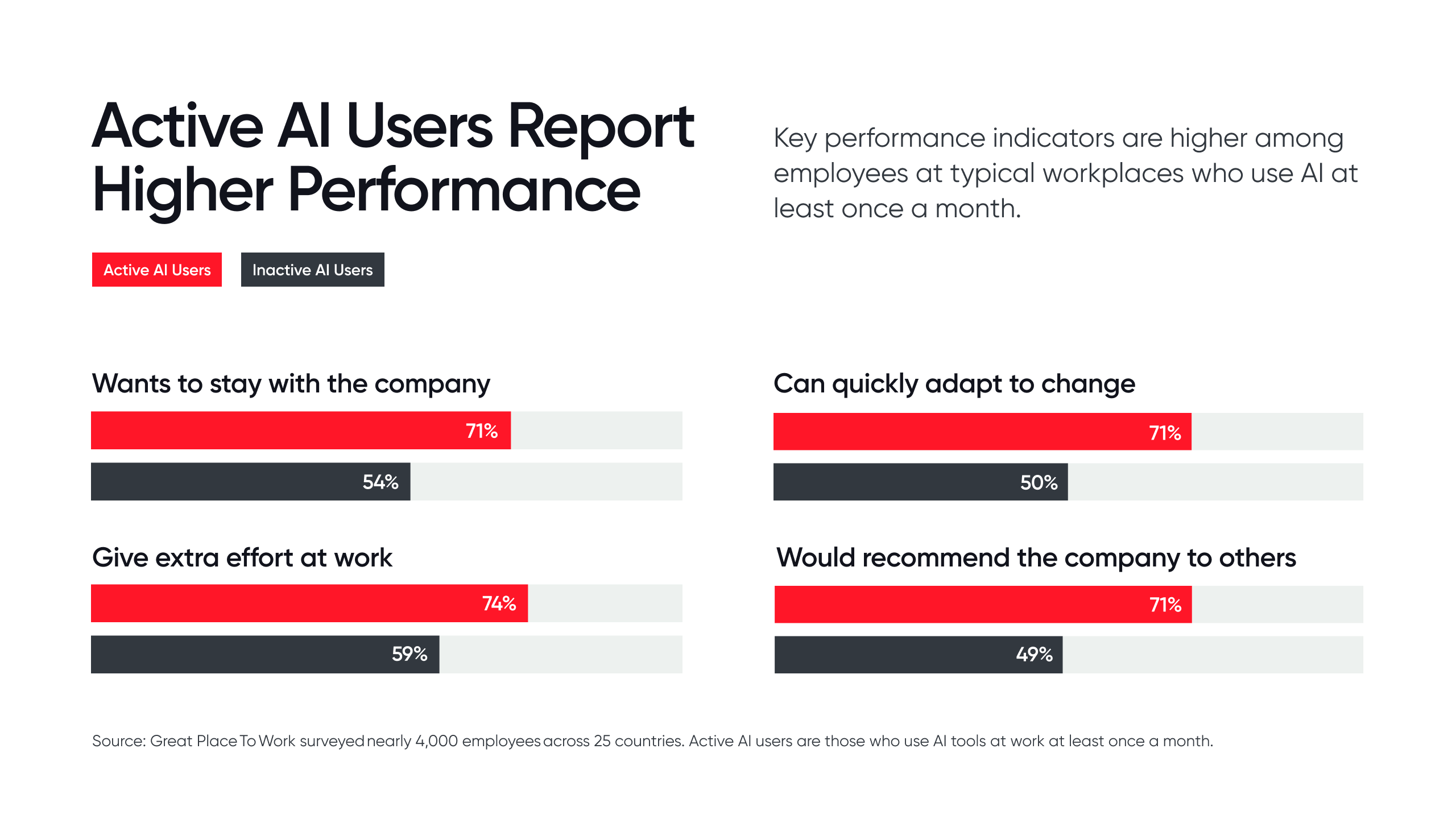
A new Great Place To Work global survey of nearly 4,000 employees across 25 countries suggests that more active AI users drive stronger business performance. The research is built on Great Place To Work’s proprietary survey data going back 30 years, which evaluates core employee experiences that drive business performance.
In its survey, Great Place To Work found that employees who use AI at least monthly were:
- More likely to give extra effort
- More likely to adapt quickly to change
- More likely to want to stay with their company
These experiences are part of The Great Place To Work Effect, a measurable pattern that proves the financial impact of company culture. Over the past 27 years, the companies with the most employee trust outperform the market by 3.5 times.
What’s holding back AI adoption?
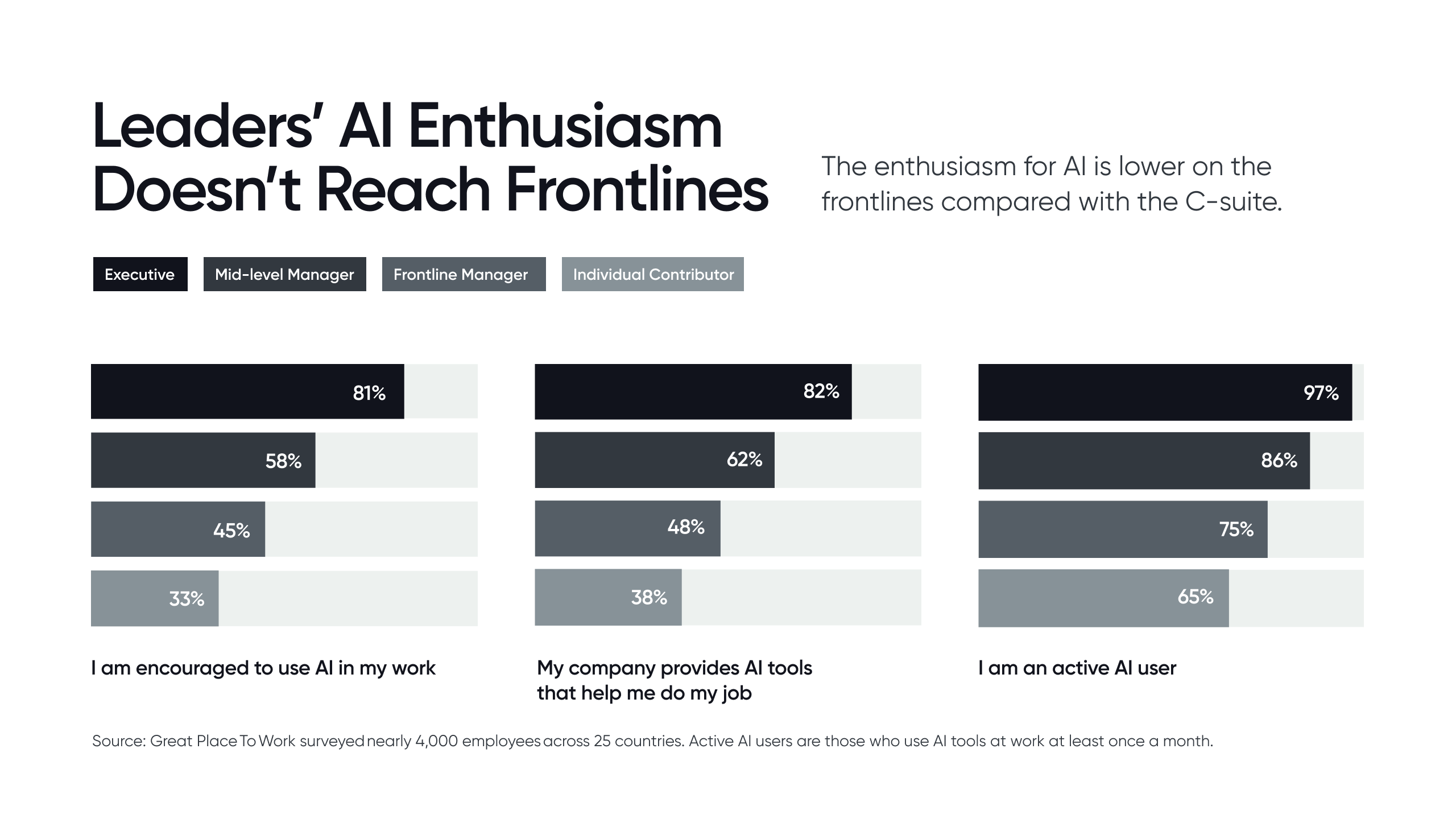
For leaders who are going all in on AI, the numbers offer some caution. At typical workplaces, the enthusiasm for AI at the top of the organization isn’t reaching the frontline.
That might be because frontline workers aren’t getting the same AI resources.
While 82% of executives said that their company provides AI tools to help them do their job better, only 48% of frontline managers and just 38% of individual contributors said the same. With more access, 97% for executives compared to just 65% of individual contributors.
What can leaders do to close the gap?
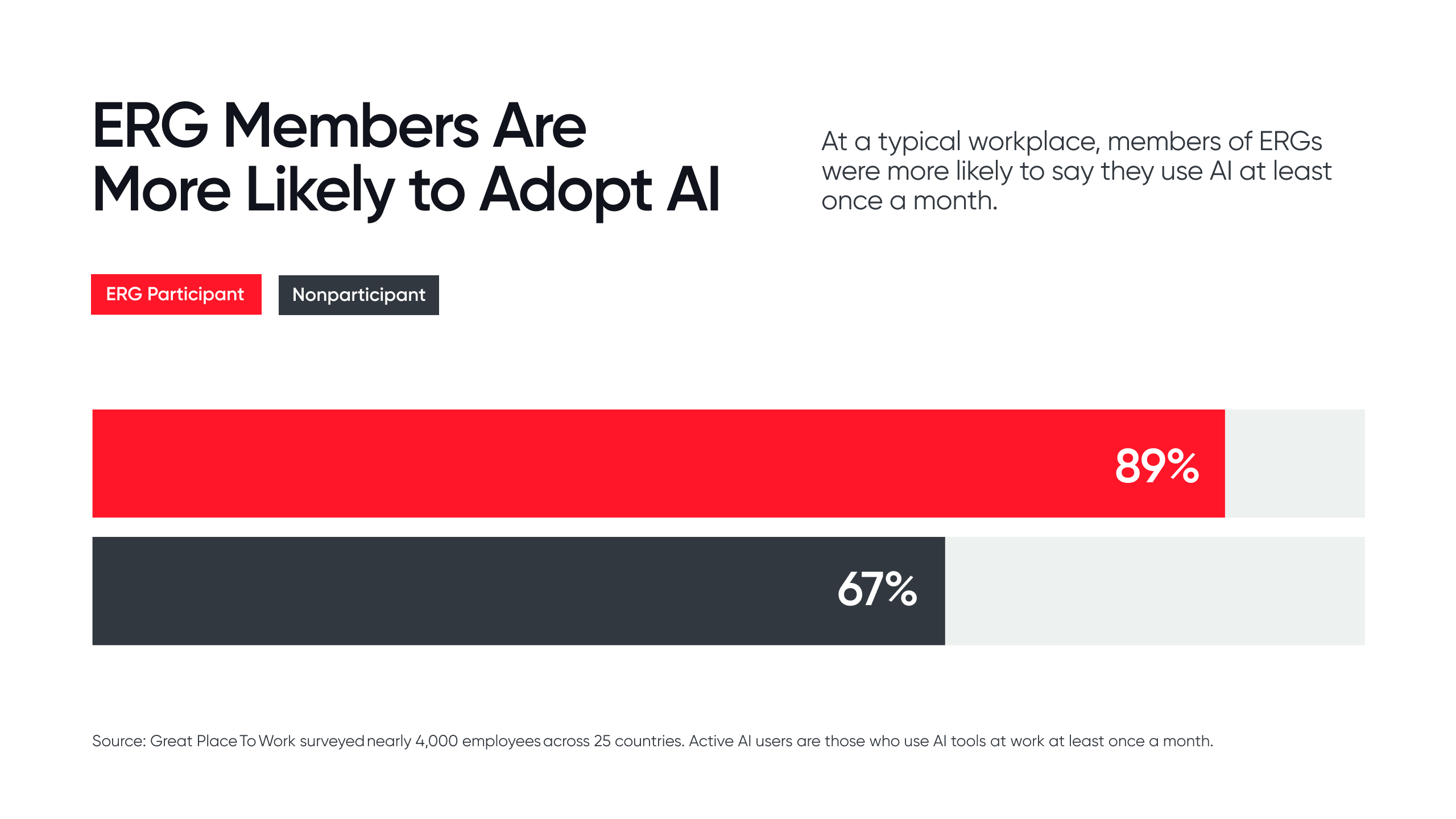
One place to start is with your employee resource groups (ERGs). In a typical workplace, employees who participated in an ERG were more likely than their non-participant colleagues to adopt AI.
This finding corresponds to Great Place To Work research into the untapped potential that can be found in ERGs. These are cohorts of employees who are volunteering their time and effort to improve the organization, share their experience and pursue new opportunities for growth.
In the pursuit of AI transformation, ERGs might be an invaluable resource for building AI momentum.
The other potent tool for leaders driving AI transformation? Clear and empathetic communication.
When employees believed leaders encouraged them to use AI, they were 2.5 times more likely to use AI monthly. When they felt leaders addressed how AI could improve their careers, employees were 2.1 times more likely to use AI.
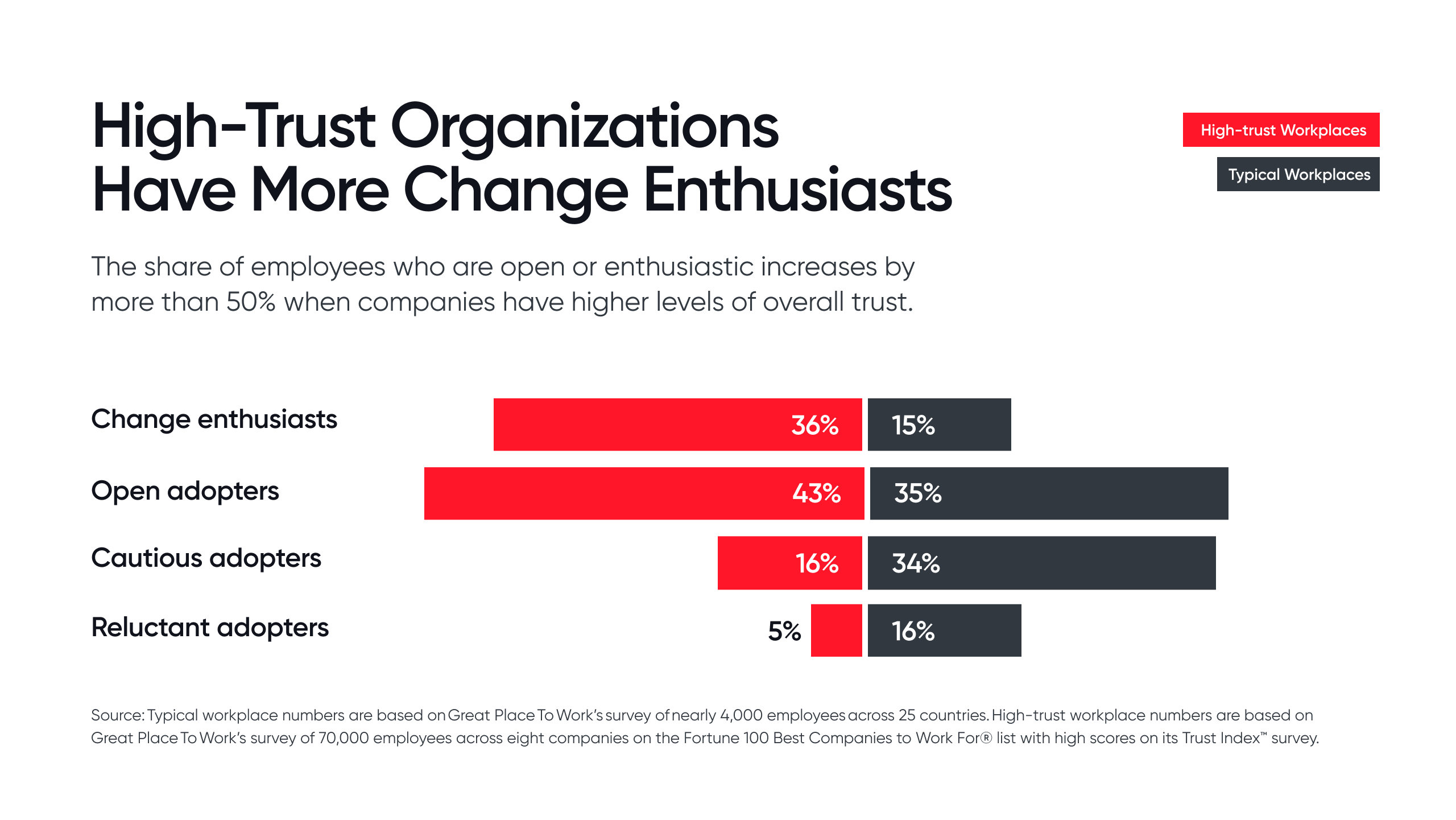
Overall, as trust improves in the organization, more employees are ready to embrace change.
At typical workplaces, only 15% of employees were change enthusiasts and 35% were open to change. In contrast, among a group of 70,000 employees from companies that made the Fortune 100 Best Companies to Work For® list, 36% were change enthusiasts and 43% were open to change. Only 5% of employees in the high-trust cohort were reluctant adopters.
Tips for leaders
Here are the action items leaders should consider:
1. Meet employees where they are.
Employees require a foundation of trust to truly unlock AI transformation. Companies should prioritize activities that build trust and start by clearly defining an AI strategy. When companies have earned that trust, AI efforts will have a far greater impact.
2. Make AI training available to every employee.
Part of the story around AI enthusiasm not reaching the frontline can be explained by access and experience. With 97% of top executives using AI at least once a month, increased familiarity with AI tools is partly driving higher levels of excitement.
3. Ensure leaders share candid and clear AI expectations.
Proactively addressing employee concerns around job losses and misalignment can help lay the groundwork for a resilient AI strategy. Leaders should share real stories of how AI augments human efforts, rather than replacing entire roles.
4. Take advantage of peer-to-peer sharing.
Networks like ERGs have higher levels of AI adoption, in part because employees are more likely to trust peers. ERG groups also provide other benefits, such as belonging and connection, which can help employees feel more supported and ready to take a risk on AI adoption.
Join the Executive Leadership Experience in Atlanta!
Turn culture into a competitive advantage and learn strategies to leverage AI to grow your business. At the Executive Leader Experience, you’ll gain proven strategies to build trust, accelerate performance, and lead with confidence in today’s market.
Register to join us May 18-20 in Atlanta!
Find your community
Connect with seasoned pros at top workplaces during our For All Summit™. Dive into the premier workplace culture conference in the country.