

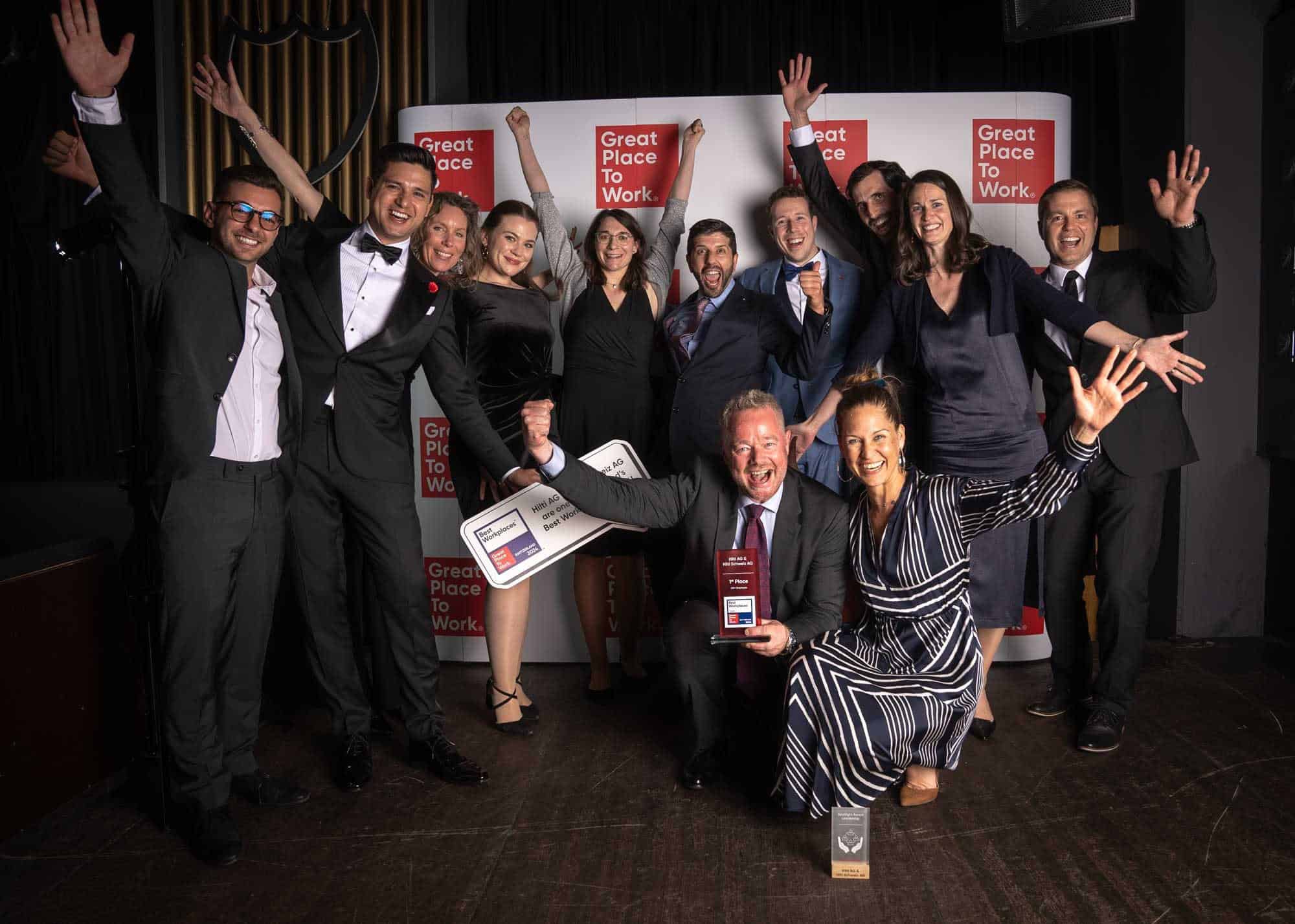

Best Workplaces, Employee Recognition
With construction continuing to face economic uncertainty, geopolitical disruption, and uneven regional demand, many companies are searching for the next productivity breakthrough. At Hilti, the answer is not confined to a lab, strategy document, or the executive suite. It is embedded in the empowerment and ideas of its people.
The company, ranked No. 11 on the 2026 Fortune 100 Best Companies To Work For™ – Europe list, has built a culture where internal mobility and innovation reinforce one another, creating a talent engine capable of driving business performance even during challenging market conditions.
In 2025, Hilti generated CHF 6.3 million ($7.95 million) in net sales across more than 120 countries, supported by 34,000-plus team members worldwide. Despite construction markets softening across parts of Europe and Asia, the company kept its foot on the innovation pedal, allocating 7% of sales to research and development and launching more than 60 new products in a single year.
Hilti’s leaders don’t describe innovation as something owned by a dedicated function—it’s part of the company’s DNA.
Innovation, democratized
This philosophy is evident in the systems designed to ensure every employee can contribute ideas. Through numerous annual innovation awards and global competitions, Hilti’s employees are regularly encouraged to identify opportunities, solve problems, and improve how work gets done. Importantly, the organization celebrates experimentation itself.
This creates measurable business value, with 79% to 90% of employees surveyed by Great Place To Work® across several European markets agreeing that people who try new approaches are praised regardless of outcome.
Consider the Hilti Finance Award: One winning idea from Southern Europe successfully automated a previously manual customer statement process. Completion time has been reduced to minutes, freeing employees to focus on higher-value work and generating annual savings. The solution proved scalable enough to be adopted in Latin America, with plans to extend to the rest of the global offices.
The company’s Hungry Lion manufacturing innovation initiative offers another example: Employees are encouraged to surface ideas, learn from experiments, and share successful practices across international production teams. The goal is not merely implementing individual ideas but creating a system that repeatedly converts employee insight into organizational progress.
Two decades, five countries, one career
What makes Hilti distinctive is how tightly innovation is connected to talent mobility. Employees regularly move across functions, business units, and geographies, gaining exposure to new markets, customers, and challenges. The result is a workforce that develops broad business understanding and fresh perspectives, both of which are critical ingredients for innovation.
As one U.K.-based employee put it: “Culture is everything for me. Since I’ve joined Hilti, I’ve had the opportunity to work in different market organizations, and I’ve felt the same corporate culture everywhere.” The employee continues: “Another thing is recognition and reward when hard work is done. When you put in the work, show ownership, bring results, opportunities are given to grow, which I very much appreciate and don’t see happening at this rate in other companies.”
Take Akash Chauhan, who joined Hilti more than two decades ago in India through a university hiring program. Since beginning his journey, Akash has worked across five countries and held roles spanning sales, marketing, training, engineering, and project leadership. Today, he serves as a construction project director in the Netherlands, steering complex global projects that require collaboration across engineering, fulfillment, legal, logistics, and other specialist teams. Few external hires could match the systems-level fluency Akash has developed simply by moving.
Mobility as strategy, not perk
Chauhan’s story points to a bigger leadership lesson: Mobility is not simply a retention strategy at Hilti. It is an innovation strategy.
When employees accumulate experience across markets and functions, they become more capable of connecting ideas, anticipating customer needs, and transferring successful practices from one part of the business to another. In an environment where customers increasingly demand integrated hardware, software, and service solutions, that organizational agility matters.
The Trust Index™ data shows employees recognize and value Hilti’s investment in their growth. Scores for professional development climb between 82% and 88% in several European markets (up to seven percentage points above the European benchmark), and workers also report strong experiences when moving between roles or work units, with 96% in Sweden and 94% in Portugal agreeing people who switch jobs or work units are made to feel right at home and nine in 10 employees across multiple locations saying they’re treated as full team members regardless of position and feel they make a real difference in the organization.
A culture that pays for itself
When innovation is democratized rather than centralized, ideas emerge from every corner of the business. Combined with genuine mobility, culture has become a business asset at Hilti—helping the organization navigate uncertainty while continuing to invest in the future.
In a year marked by market headwinds, employee engagement increased, innovation investment held firm, and the company entered 2026 committed to expanding its portfolio of hardware, software, and services.
Sustainable performance often begins with a simple question: How effectively are your people able to grow, contribute ideas, and move where they can create the greatest impact?
Hilti’s answer has become its competitive advantage.
Get recognized for your culture
Gain accolades for your workplace environment and attract top talent who share your values.