



AI (Artificial Intelligence), High-trust leadership
The reason your AI efforts are going nowhere? Look in the mirror.
The AI discussion at work is shifting from “How do we get more employees to use this?” to “Why isn’t this paying off?”
Companies like Uber report a missing link between AI spending and return on investment, even as costs balloon. (Uber spent its entire 2026 AI coding budget in just four months.)
Where are companies going wrong?
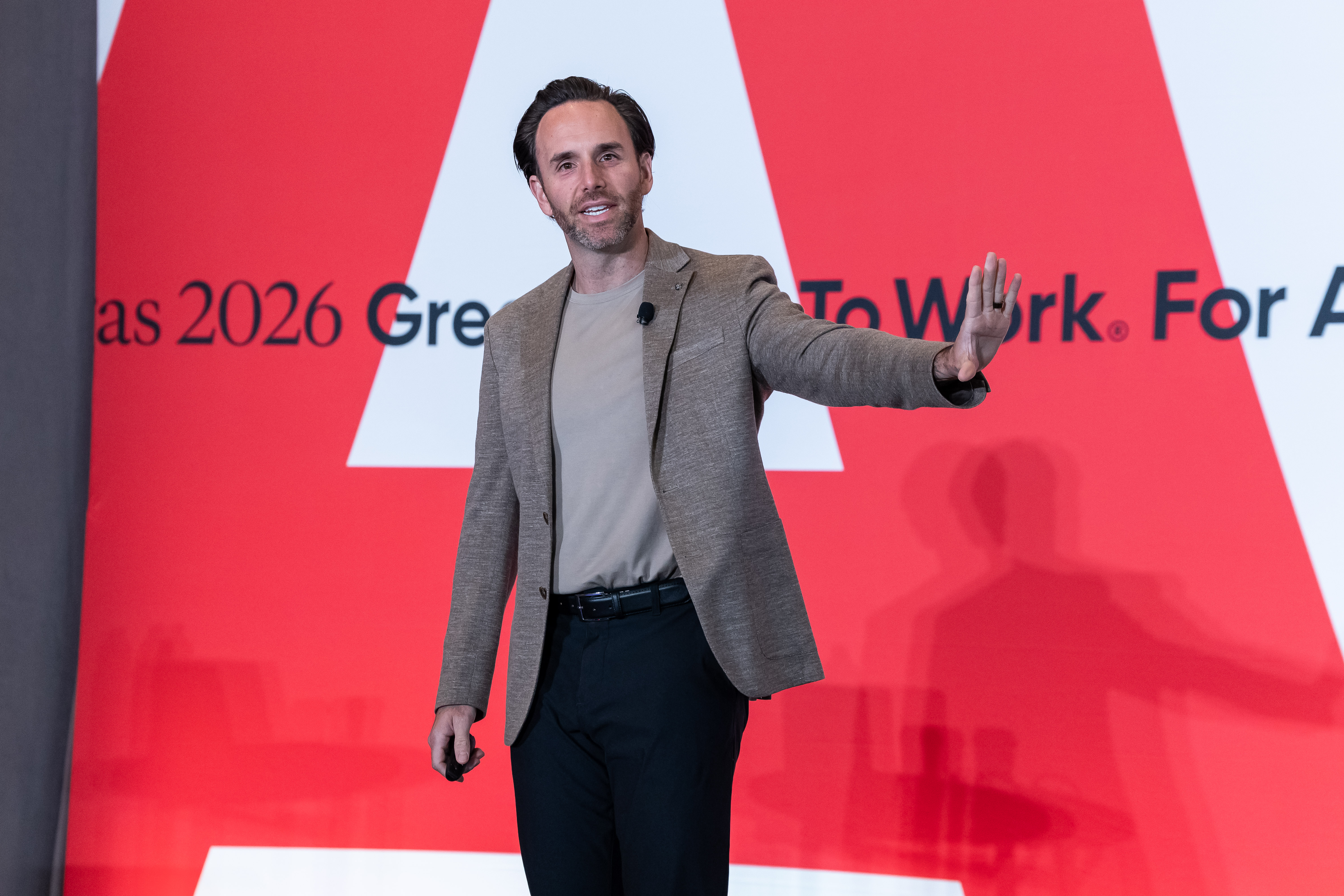
At the Great Place To Work® For All Summit™ in April, Geoff Woods, best-selling author of “The AI-Driven Leader,” gave a simple answer: Leaders are using AI to solve the wrong problems.
AI mistakes leaders must avoid
Woods shared six mistakes that derail an AI strategy:
1. Senior leaders don’t model AI use.
If leaders don’t use AI themselves, adoption stalls. Great Place To Work research found that employees who trusted how their leaders encourage them to use AI are 2.5 times more likely to use AI monthly.
“The No. 1 determinant of ROI with AI has nothing to do with tech,” Woods says. “It’s the CEO’s direct oversight.”
2. AI processes aren’t built in collaboration with employees.
AI strategies fail without input from the people doing the work, Woods says.
“If you cannot truly align with your workforce on where we are going and unlock the voices of your organization so that they buy into the change and feel like they're co-creating it — they will resist it,” Woods says.
A report from Writer found that 29% of employees admit to sabotaging their company’s AI strategy.
3. Leaders use AI only for low-value work.
Many leaders use AI to replace Google searches or write better emails. That’s helpful, but not that valuable.
Woods frames the dilemma as an 80/20 split: Leaders must identify the 20% of tasks that drive 80% of value for your business. “How many people get promoted because of how well they write an email?” he asks.
4. Leaders put the tool ahead of the strategy.
“For a guy who wrote a book about AI, I don’t care about AI,” Woods says. The goal for any leader isn’t to use as much AI as you can — “tokenmaxxing” is just a great way to spend a lot of money.
AI is a tool, not a strategy, Woods says. “It can help you achieve your goals; it can also distract you from your goals.”
If your only goal is to use more AI, you risk becoming a hammer in search of a nail, he says.
5. Leaders don’t give AI enough context.
If AI isn’t giving you useful answers, the problem might be a lack of context.
“When you think you have given enough context, assume you have not,” Woods says. “Give it more.” That’s why Woods developed the CRIT™ framework to improve prompts and provide more detail for the AI.
He offers two tips:
- Ask AI to interview you about the problem. Even three questions can improve the response.
- Use AI voice-to-text capability. “When you type, you edit yourself,” Woods says. Speaking can give AI richer detail.
6. Leaders trust AI too much.
“One of the greatest risks with AI is people are outsourcing their thinking,” Woods says. “Your brain is like a muscle. If you outsource your thinking, it will atrophy over time. You make AI the thought leader, and you become its partner.”
The best AI users don’t just accept answers. They challenge and refine them, telling their AI what they like about an answer or what they don’t like. That’s what keeps AI useful — and keeps leaders from handing over the thinking that makes them valuable.