



Employee Well-being, Gen Z, Research
Well-being levels for employees fall as levels for leaders rise.
The latest “Well-Being at Work” report is a sobering reality check.
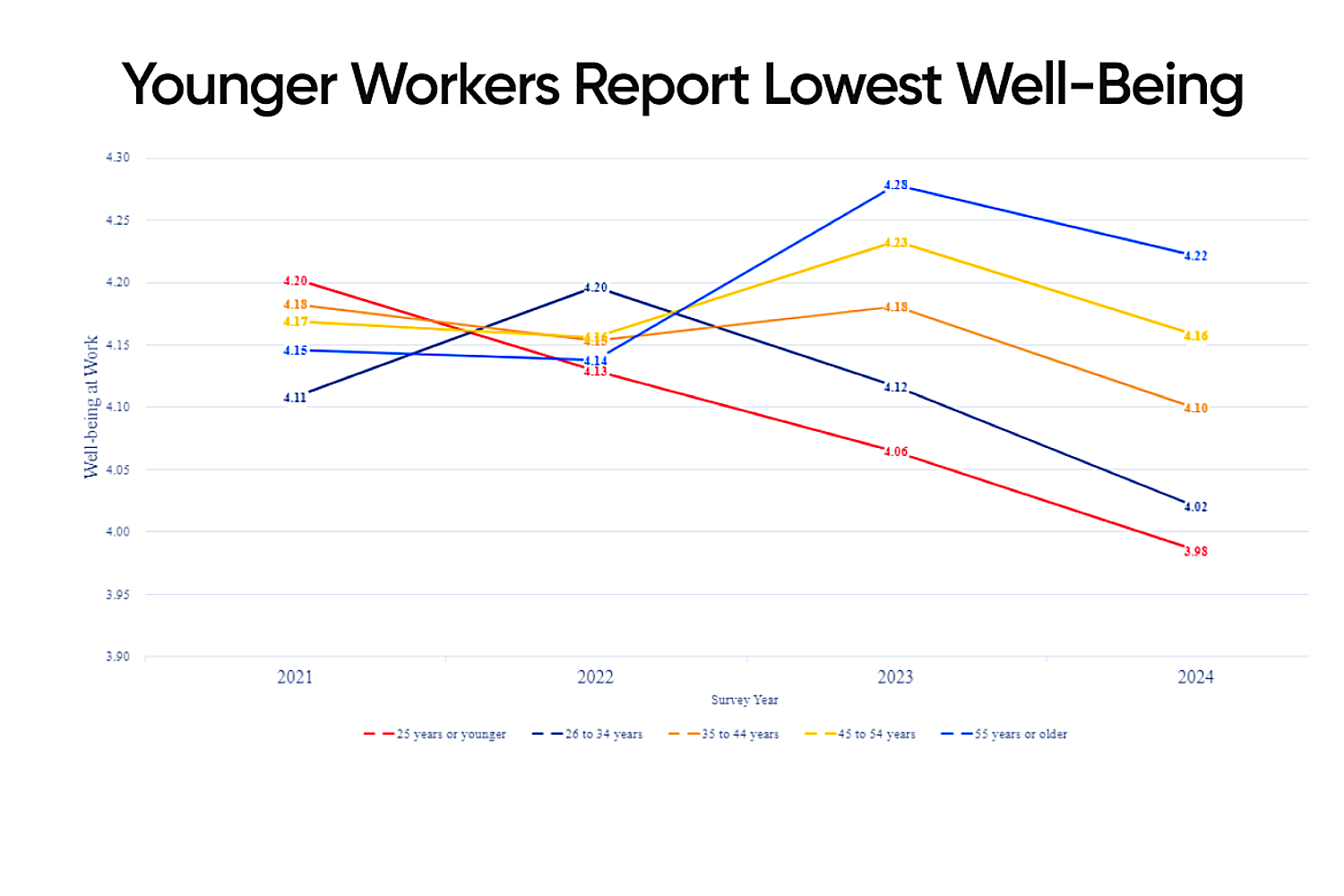
Well-being has hit a five-year low — the lowest since researchers from Johns Hopkins Carey Business School, in partnership with Great Place To Work®, began tracking it in 2019.
Scores briefly improved during the height of the pandemic but have now dipped below pre-pandemic levels.
After analyzing more than 1.3 million employee survey responses across 2,700+ organizations, researchers found several groups who are struggling more than others:
- Workers under age 25 have experienced the sharpest decline
- Levels for leaders and managers rose the most, while individual contributors fell
- Women are faring worse than men
- Caucasian and Asian employees score higher than Hispanic, Black and multi-racial employees, who report the lowest levels among ethnic groups
What’s driving lower levels is likely a combination of mandates, reduced flexibility, inflation, AI, and geopolitics — especially for young workers and non-managers — and costing workplaces tremendously when it comes to business success.
“We overlook how much well-being is actually tied to performance,” says Joanna Poz-Molesky, principal at Great Place To Work. “If we think about how supported people might feel in the workplace — if they’re excited and engaged and feel like they have the tools and resources needed, that drives higher performance.”
This has been proven in the Great Place To Work Effect, which shows that companies with strong cultures outperform in revenue, productivity, agility, innovation, and psychological safety.
4 things every leader can do today
1. Listen more. Listen differently. Listen to all.
What seems simple, like listening,is often overlooked.
“Employees are the ones who are going to tell us how they want their environments shaped to create that safe workplace and a workplace where they’re excited to come every day,” Poz-Molesky says.
Don’t assume you already know how to listen. “Listening isn’t just about opening our ears. It’s asking questions, it’s being open to responses. It’s letting your employees know you’re listening, that you’ve heard their feedback. Thank them and follow up with them if there isn’t a change.”
Companies that listen well act on what they hear. Some companies, like Synchrony, have brought in on-site psychologists.
And most important: Avoid listening to a select few. “It’s important to listen to all of your employees in unique ways because people express information differently,” she says.
“Too often, leaders are spending time with employees when they (the leaders) have an agenda or something to share — however, when a leader engages with employees and has no agenda, then he/she can better understand the well-being and concerns of their employees,” says Richard Smith, professor and director of the Johns Hopkins Human Capital Development Lab
2.Create space for connection.
Connection doesn’t happen only in 1:1s or company meetings. Leaders need to make ongoing space for it. Ask yourself:
This is particularly important for younger and early-career employees who are struggling the most.
“Especially with younger, more entry-level people, let them know it’s OK to reach out and connect, and it’s helpful for various reasons. That way, as a leader, you’re not actually putting time on the calendar, you’re creating the space for it and simultaneously empowering them to take ownership.”
With less learning and development happening organically, and more remote or heads-down work, intentional connection becomes essential.
“It goes back to connection at work,” Poz-Molesky says. Either you’re isolated as a remote employee, or sometimes even if you’re in-person, there’s less connection because there’s work that needs to get done and you’re moving fast.”
3. Make mentorship accessible.
It doesn’t have to be formal. “We see these senior leaders, and we see their success as people, but they’ve also had their own challenges,” she says. “We know that those two-way roads are really helpful for young people.”
These conversations:
- Build trust
- Help employees feel seen
- Encourage authenticity
- Spark collaboration and innovation
“Two-way conversations help weave trust, confidence, and authenticity together - all crucial to building well-being - and in turn, inspiring innovation,” Poz-Molesky says.
4. Close the gap between levels.
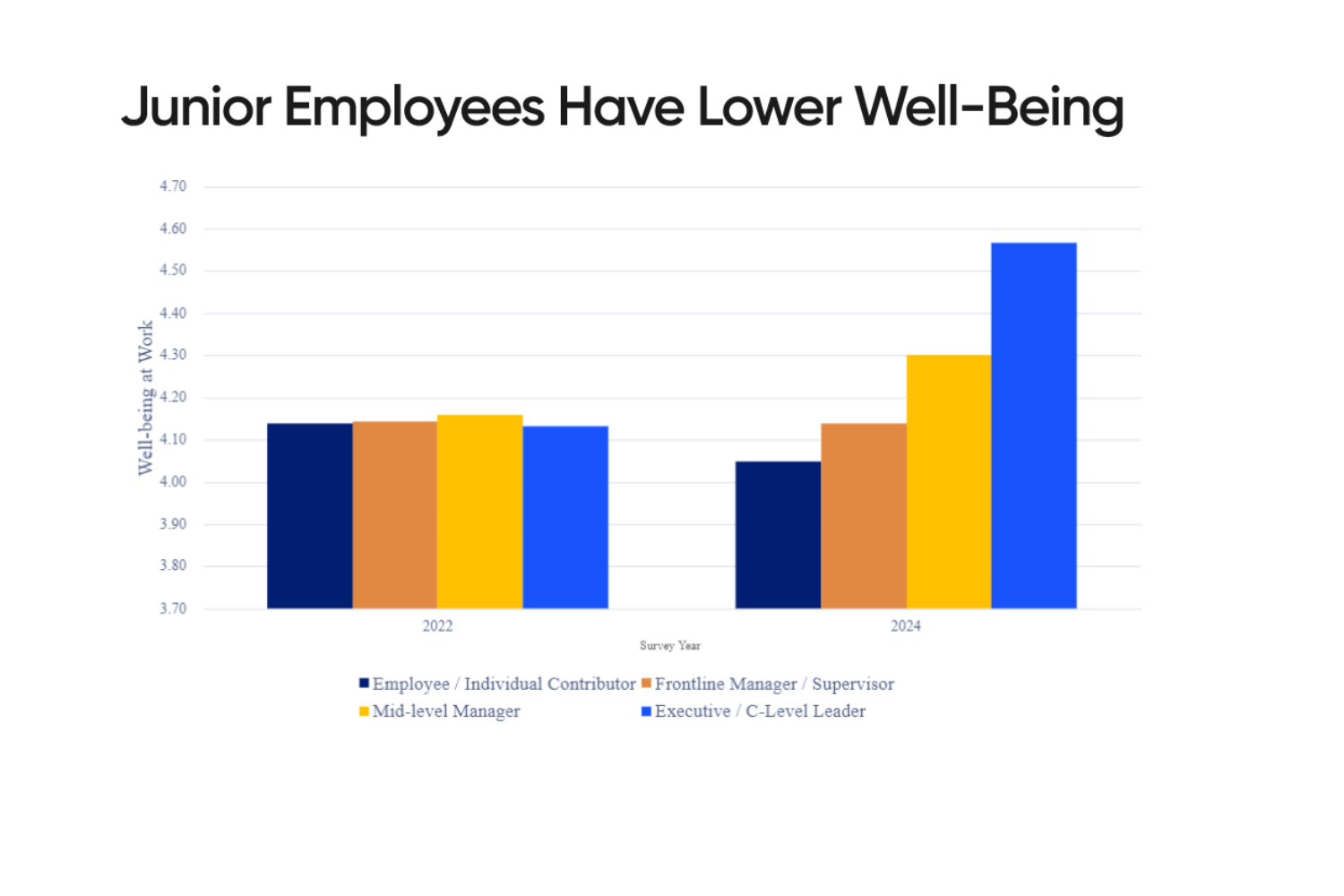
Leaders’ well-being is rising while employees’ well-being is declining.
During the pandemic, levels for managers were lower than those of employees, due to increased pressure. But in 2022, levels flatlined to just above 4.10 on a 5-point scale. And today, leaders are at 4.55 — the highest of any job level — while individual contributors have dropped to 4.05.
“During the pandemic, we witnessed senior leaders spending significant time to address individual employee needs, health, and well-being — this was admirable and set a new standard. It is disappointing to see that we have reverted to old management patterns that show less concern for employee well-being,” Smith says.
“Senior leaders can make a huge impact with employee well-being with minimal effort if they spend time to take a personal interest with their people,” he says.
The bottom line: resilience must be built daily
“Well-being has felt like a back-burner activity for many companies, but it's tied to performance and a big part of that, especially for 2026, will drive resilience within organizations,” Poz-Molesky says.
Resilience is built daily through care, listening, and support.
“How are you showing up as a leader in a human, authentic way to support your employees? That drives resilience, which then feeds into everything else,” Poz-Molesky says.
Find your community
Connect with seasoned pros at top workplaces during our For All Summit™. Dive into the premier workplace culture conference in the country.