


AI (Artificial Intelligence), Listening
Your frontline workforce should be your most tech-savvy population.
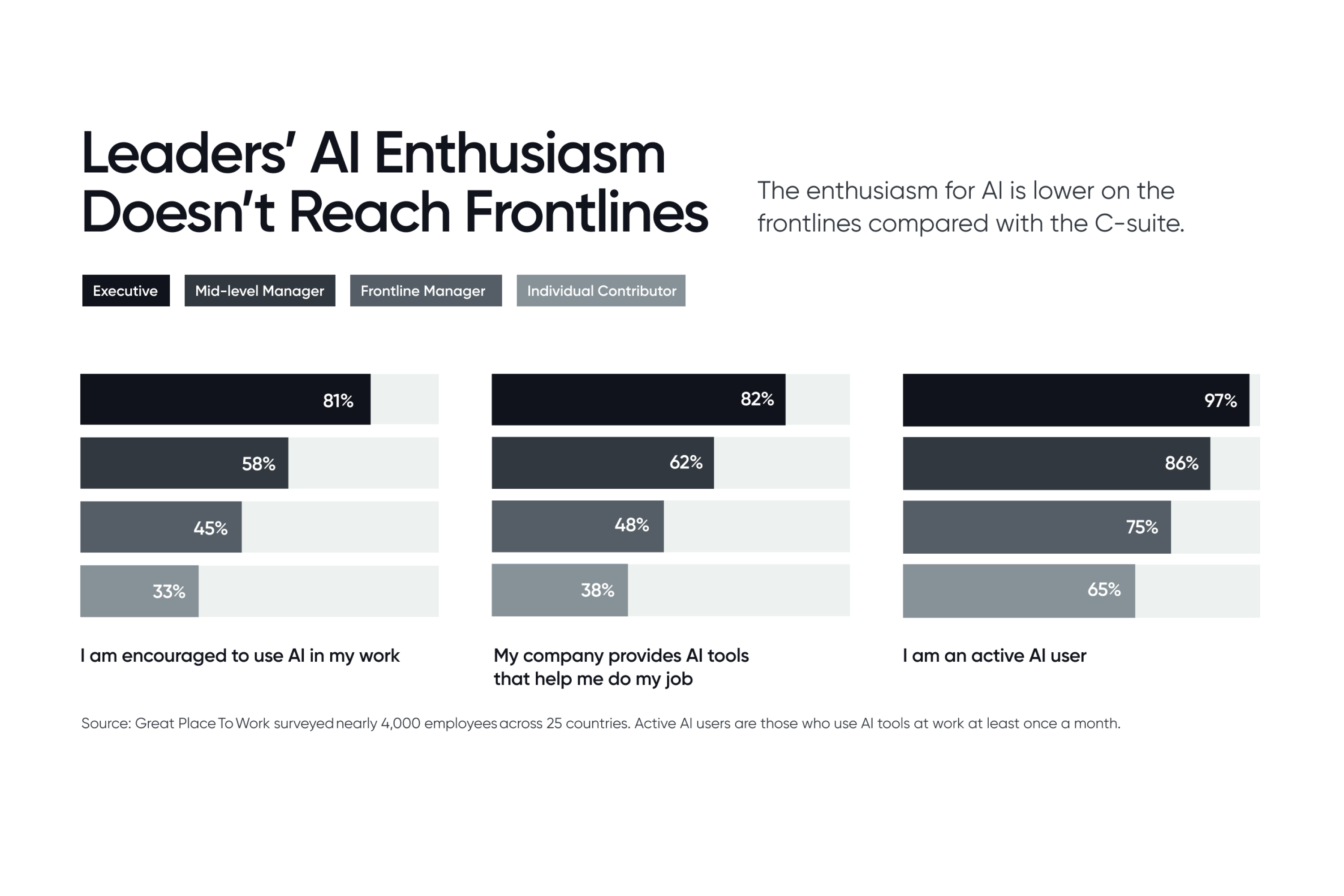
Your frontline workforce is less likely to actively use AI compared with senior leaders, according to data from Great Place To Work.
Surprising? It shouldn’t be.
There are compelling reasons for frontline workers to be less ready to adopt AI, says Kelly Monahan, a future of work researcher with past roles at Accenture, Deloitte, and Meta.
“No. 1 is the inherent nature of their job,” she says. “They are deskless, which means the entry point for AI and technology is a lot more disruptive to their workflow.”
Frontline employees are also more worried about surveillance. Even programs with a benevolent design can create unintended headaches. Monahan’s example is a delivery car service driver who had an AI coach start critiquing his driving on a recent trip.
“Whoever designed it didn't actually think of the frontline experience in mind. Yes, that's a good potential use case, but for the driver, it led to embarrassment.”
Because they often work on-site and may have commutes or other time pressures, frontline workers have less time available for learning.
What we’re getting wrong about AI at work
For most companies, AI starts and ends with the chatbot. That’s a mistake, according to Zack Kass, former go-to-market lead at OpenAI and author of the new book “The Next Renaissance: AI and the Expansion of Human Potential.”
“I challenge everyone to frame this technology not as a tool, not as an app, but as infrastructure,” he says. “It's powering the electrical grid. It's making produce harvesting far more efficient. It's helping cars navigate the roads, right? The best technology is invisible.”
These invisible use cases are going to have profound impacts on frontline work, Monahan says.
“Think about it as ‘ambient AI,’” she recommends. “It's the sensors that are in factories right now and in manufacturing. This is not just large language models for frontline workers.”
It’s also a mistake to think that frontline workers are not tech-savvy. Quite the opposite.
“This is not a less technical workforce,” Monahan says. “Frontline workers are actually going to be some of our most technical workers in the long run, especially as Ambient AI becomes more mainstream.”
Monahan writes about this in her book “Essential,” (co-written with Christie Smith) and what they call the “gray collar” workforce. “Everything is becoming much more blended into both physical and digital environments.”
“People are going to be left behind if we don't teach them how to work with this because this is going to be mandatory for warehouse workers moving forward,” Monahan says.
Finding the boundary for automation
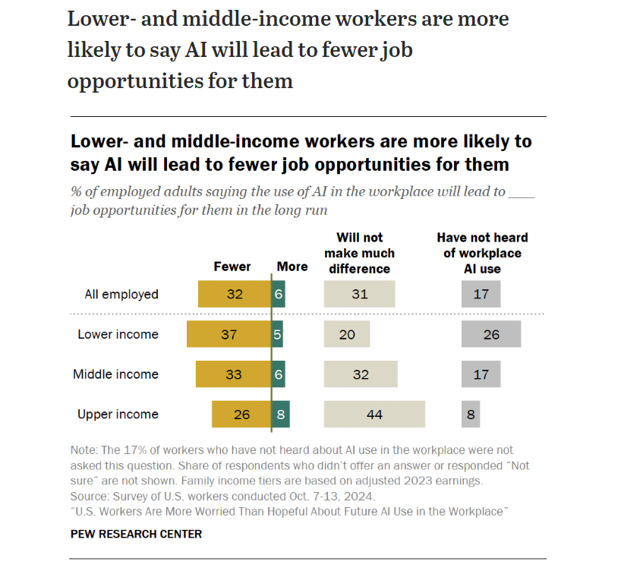
For many companies, rolling out AI technology is all about efficiency. However, the drive for efficiency is alienating frontline workers. About half of workers are “worried” about how AI will be used in the workplace (52%) compared to just 29% who are “excited” according to Pew Research. Lower- and middle-income workers are more likely to say AI will lead to fewer job opportunities for them.
One thing that isn’t being communicated is the purpose behind increased efficiency. Kass argues that businesses need to do a better job explaining how increased efficiency will benefit all stakeholders, including workers.
“What is the point of efficiency? The point of efficiency is actually expanded access,” he says.
“Companies that provide a service are trying to figure out how to make that thing or provide that service at lower cost,” he says. “In most cases, we all want people to have more access to food stuffs, more access to good education, more access to healthcare.”
However there will be things that people do not automate to the point of perfect efficiency. Kass gives the example of the coffee shop: “They would love if you stood up at the counter and already had your order placed. What they don't want to automate is the experience with the barista because that matters to people.”
This becomes what Kass calls the “automation boundary”: a thought experiment to uncover where people really value human inefficiency in a system.
“It's a fun dinner table conversation,” Kass says. “There are people who love doing dishes — it’s cathartic for them. Other people are like, ‘No! Why would I do that? ‘”
His point is that every business will have to discover this boundary where they want something automated versus human. He frames the debate: “Drug discovery we would love to be fully automated. Dining at a nice restaurant? I don’t know if that needs to get much more efficient.”
How businesses can engage frontline workers with AI
How AI transformation progresses in your company has a tangible impact on your business. In its survey, Great Place To Work found that employees who use AI at least monthly were:
- More likely to give extra effort
- More likely to adapt quickly to change
- More likely to want to stay with their company
Here’s what leaders can do to get the frontline involved with AI:
1. Improve employee listening
“I don't think we're getting [the frontline employee’s] voice enough,” Monahan says. Empowering and engaging frontline workers is a proven strategy for innovation and performance.
“Why did Toyota outpace American car workers for so long?” Monahan gives as an example. “It's because they were listening at the very front lines of where things were getting stuck in the assembly line, where there was friction.”
2. Challenge the “tyranny of incremental gains”
“Most people see [AI] as a way to write a slightly better email,” Kass says. He wants more leaders to ask a different question: “What if this was a way to actually radically improve how you run your business?”
He recommends asking ChatGPT or another LLM to find ways to jump the curve and radically improve systems in your organization. “You have a tireless savant in your pocket — take full advantage of it.”
3. Increase transparency about AI use
“I’m really fearful that especially ambient AI will be used for surveillance,” Monahan says. “I do not thing that’s the proper use case.”
Transparency will be required to build trust with frontline employees.
4. Redefine the metrics for success
“It's not hours or minutes saved on the front lines; that is the wrong measurement,” Monahan says. “When it comes to the front lines, I want to see measurements around safety. I want to see measurements around worker confidence and better customer experience.”
That’s the alignment that will lead to unblocking the full potential for AI-enabled frontline roles.
Turn culture insights into business wins
Let the Trust Index™ Survey reveal your workplace’s hidden strengths and areas for growth. Start transforming today.