
AI (Artificial Intelligence), High-trust leadership, Productivity
If everyone is saving time using AI, where is the return on investment?
Chances are, your business is more productive than it was a year ago.
Almost all CEOs in a recent EY survey reported productivity growth in the last 12 months. Half (50%) said AI tools were the biggest driver of those gains.
That doesn’t mean that productivity gains are resulting in higher margins for the business. Only 6% of companies are getting measurable financial returns that they can show to investors, McKinsey’s Kate Smaje told The Wall Street Journal.
Where are those productivity gains going?
Almost a quarter of CEOs in the survey said the gains are being absorbed by organizational complexity and bureaucracy rather than being reinvested in future growth.
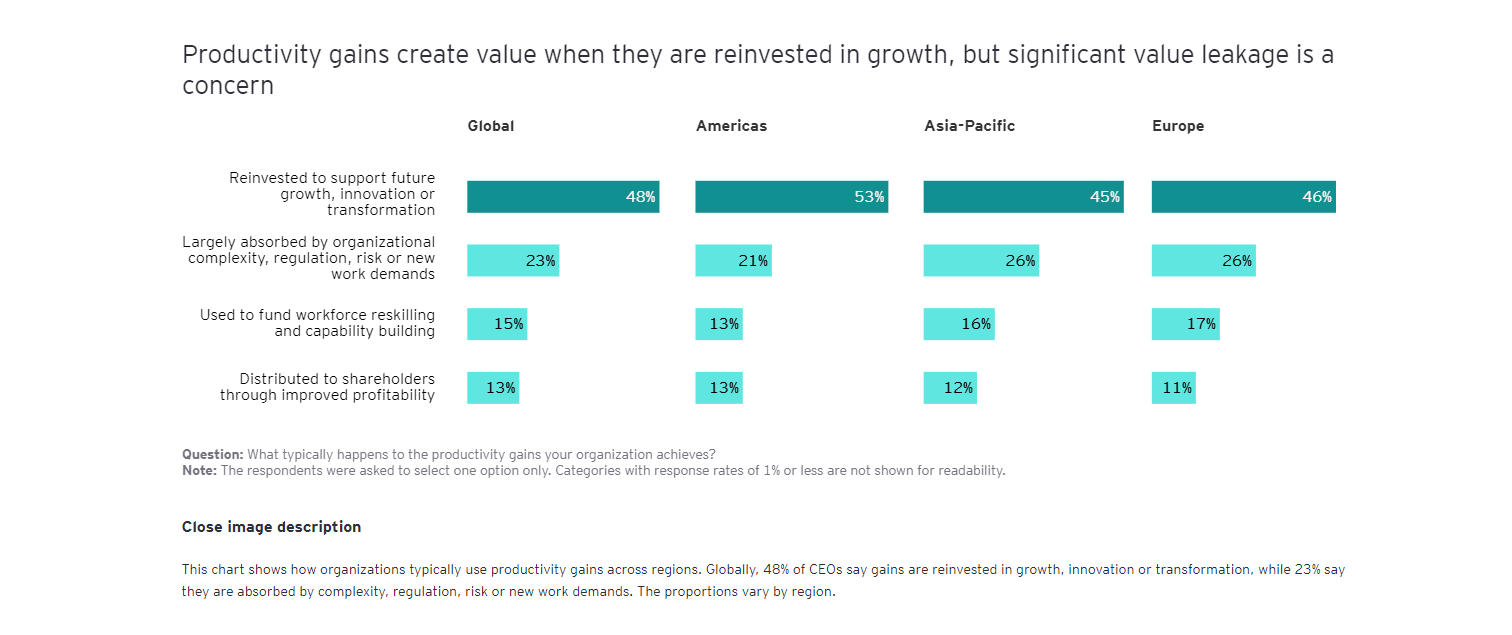
(Source: EY)
Put another way: The time people saved by using AI didn’t turn into revenue.
The problem with measuring productivity
How you measure productivity might be part of the problem.
Many organizations focus on time savings. New data from the U.S. Census Bureau found that 55% of workers say they use AI at work and one-third of those save one or two hours per assignment.
However, there is no guarantee the time saved is spent on work that creates business value.
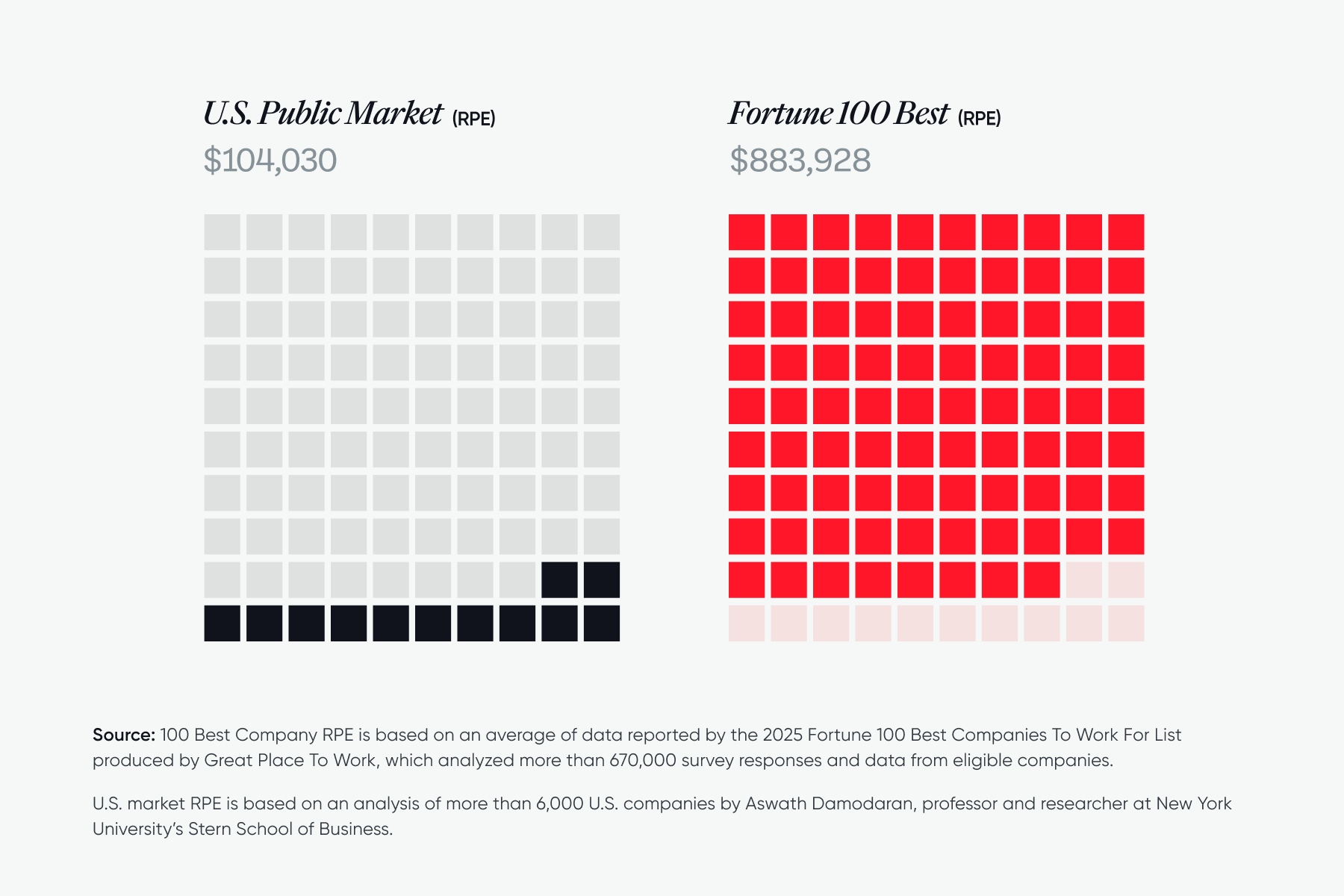
If you want to measure productivity in a way that impacts your bottom line, a better metric is revenue per employee.
At the Fortune 100 Best Companies to Work For®, revenue per employee is 8.5 times higher than the typical U.S. workplace. Those same companies outperform the stock market by a factor of three over a period of nearly 30 years.
Only 16% of CEOs say they have clear, real-time visibility into AI’s return on investment, according to EY. For the remaining 84%, some of the signals they’re missing can be found in the experience their employees are having.
You can measure the friction slowing your team
Cooperation is the No. 1 driver of productivity, according to Great Place To Work’s proprietary workplace intelligence about the most successful workplaces. People are eight times more likely to be productive when they can easily collaborate.

That means AI tools alone aren’t enough to drive performance. Leaders need to know how technology investments are removing the friction that prevents people from making progress.
One example is “botsitting,” the hours spent reviewing, fixing, or managing AI-generated output. While workers say AI automation saves them 11 hours a week, per a report from Glean, 6.4 hours of that time went into reloading context into AI tools, cleaning up AI-generated work, comparing outputs when the first answer wasn’t good enough, verifying accuracy, and more.
For employees doing a lot of “botsitting,” there is a cost. Nearly three in four (73%) employees who frequently manage AI output are more likely to be actively looking for another job, Glean found.
Here are three questions leaders should ask:
1. How can I measure the success of AI beyond time savings?
The metrics you track shape how employees will use AI. Prioritize the wrong incentives, and you could end up with lots of AI use, but little value created.
From a macro view, leaders should look beyond time savings and ask for the connection to revenue and growth.
2. What employee experiences predict higher levels of productivity?
Do you know why some employees go above and beyond on a project when others don’t? The difference is often less about technology and more about whether people have the support, trust, and cooperation they need to do their work.
3. Who in my company is experiencing the lowest levels of cooperation?
When people aren’t getting what they need to do their jobs, work slows down. Teams with low levels of cooperation are a signal worth every business should monitor closely.
Ready for a deeper conversation? If you want to see what your employee experience reveals about productivity, growth, and performance, Great Place To Work can help you answer them and benchmark against leaders in your industry. Get in touch.