



Rising uncertainty and rapid change demand that leaders take a different approach to the workplace.
Business leaders are increasingly concerned about uncertainty.
Four in 10 CEOs (43%) in a Conference Board survey say it’s the biggest external risk to their business. Economic volatility, geopolitical change, and the rise of AI are all driving that concern.
Uncertainty has a direct impact on your workforce.
“There are a lot of associations that people have with uncertainty,” shares Matt Bush, senior principal at Great Place To Work®. Using employee survey data, Great Place To Work analyzed the words employees most commonly associate with the idea of uncertainty: “anxiety, unease, confusion, and distrust.”
That’s a problem for workplaces where trust is a crucial driver of performance. Companies with higher levels of trust outperform the stock market by a factor of three in long-term returns. Higher levels of innovation, agility, and engagement create the Great Place To Work Effect, where culture leads to measurable financial results.
To respond to rising uncertainty, leaders are working to build resilience.
“Many employees, particularly in more junior roles, lack clarity, direction, psychological safety, and training,” Bush says. “Without these experiences, employees aren’t embracing the pace of change rippling through organizations.”
What builds resilience
There are three primary levers for organizations to increase resilience in the workforce:
1. executive leadership
2. mid-level managers
3. employee resource groups (ERGs)
“The data show these groups place a significant role in driving experiences like psychological safety and clear communication,” Bush says.
Measuring those experiences comes down to asking two key questions:
- “Do managers involve people in decisions that affect them?”
- “Do managers have a clear vision for where the organization is going?”
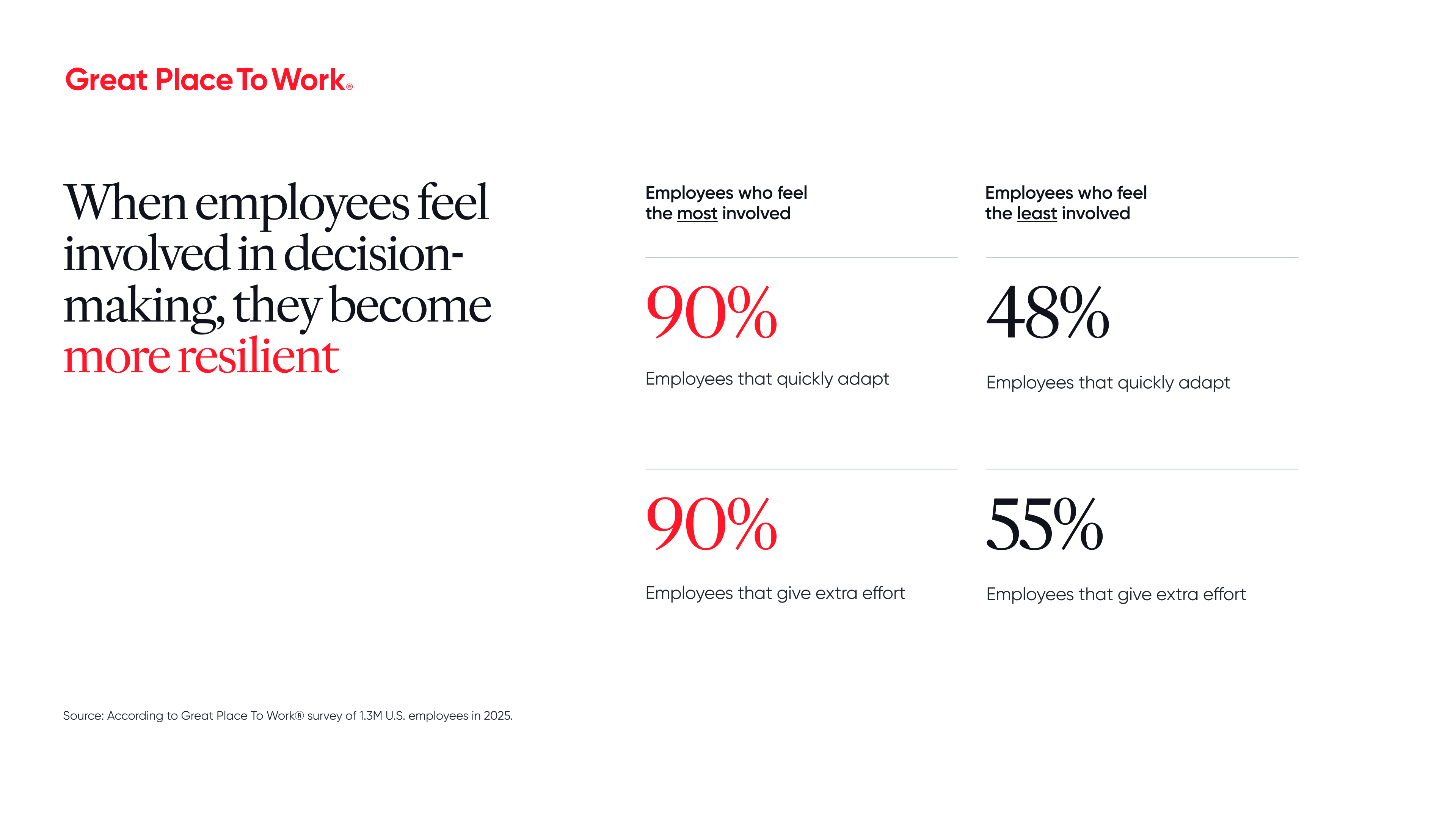
The difference can be striking. When employees are involved in decisions that affect them, 90% report giving extra effort and quickly adapt to change.
That’s much higher than the number of employees who are less involved in decision-making.
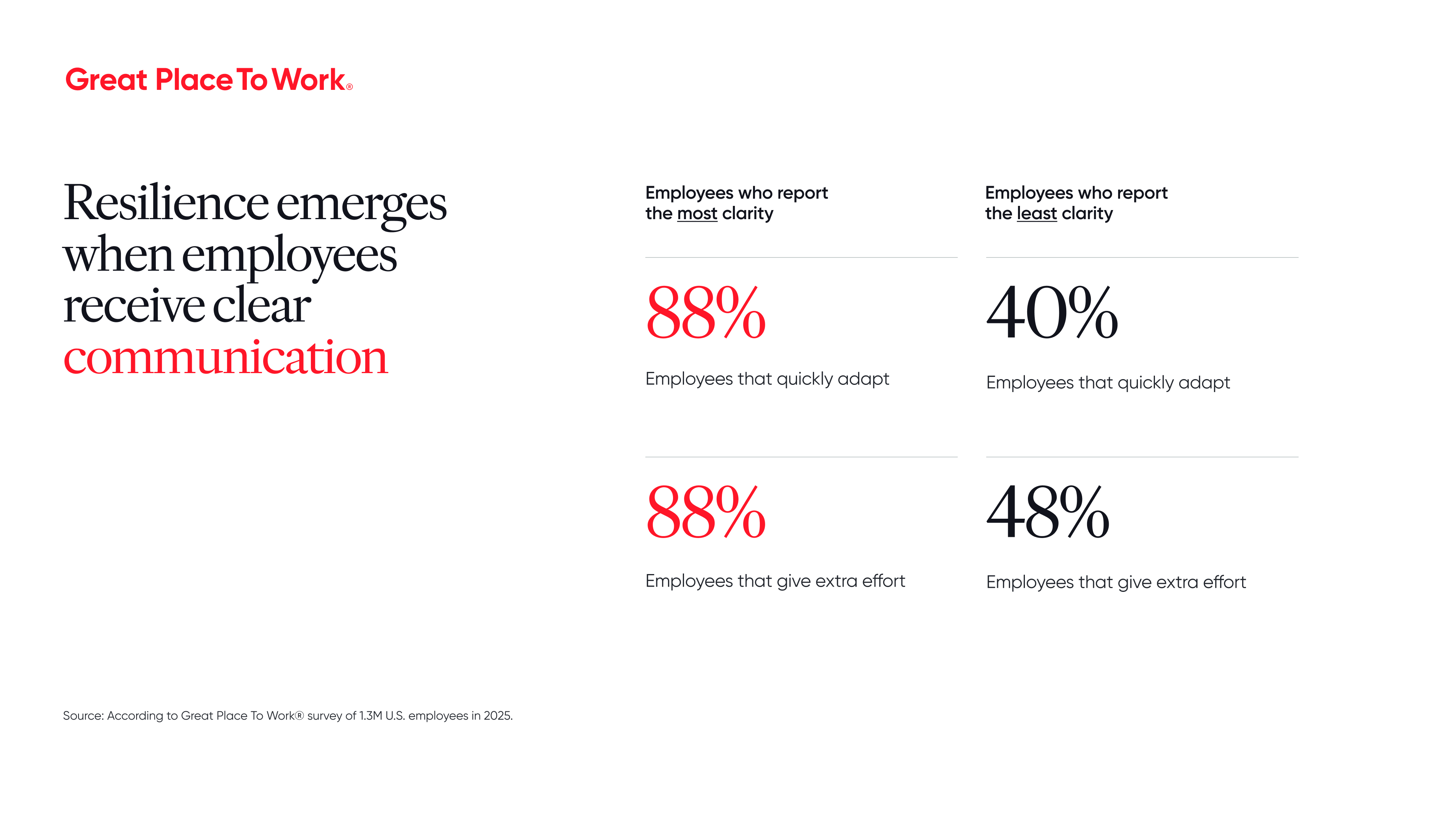
Clear communication is equally important for resilience, driving similarly high gains in agility and discretionary effort.
Senior executives and middle managers are part of a cascade where things often fall apart before reaching the front line. Great Place To Work data shows that trust declines as you move down the organization.
Bush gives an example: “How would you feel if you were an employee and you heard from your CEO that everyone needs to be using AI, but when you ask your manager for AI training, they say, ‘No, don’t worry about that.’”
The employee starts to feel like they’re not a part of the future and disengages.
Most common leadership mistakes
Where are leaders getting it wrong with resilience in the workplace? Bush shares some common missteps:
1. Leaders think they’re listening and communicating clearly — but they don’t double check.
Most leaders live in a bubble.
You probably think you are communicating clearly, but how do you know? “You need to listen to employees to see if you're hitting the mark,” Bush says. “It’s very common for intent and impact to have a mismatch.”
You have to meet your workforce where they are. That means consistent listening and adjusting along the way.
2. Good leadership requires being more proactive.
If you rely too much on cascading communication, where mid-level managers share messages they receive from senior executives, you will see a breakdown in trust.
Just passing along a message isn’t enough, Bush says. Good middle managers translate company priorities to fit the reality of their team on the ground. Good organizations equip their managers to do more than parrot talking points.
3. You’re just adding more to leaders’ plates.
Leaders already face a high administrative burden and culture-first initiatives can add to burnout. “The last thing companies want to do is ask leaders to do more,” Bush says. Instead, companies like Synchrony, No. 1 on this year’s Fortune 100 Best Companies to Work For® List, start the conversation at the very top of the organization.
When Synchrony launched a leadership development program, it started with the most senior leaders, including CEO Brian Doubles. Rather than doing new things, leaders were asked to simply approach their current tasks differently. As the program onboarded more leaders, they could look to the CEO and his senior team to understand the importance of the new leadership strategy.
“Don’t ask people to do something you aren’t willing to do yourself,” Bush says.
4. You’re not taking advantage of ERGs.
ERGs are a powerful tool for resilience and can provide essential support to employees navigating change. For example, ERG members are more likely to make the connection on how AI can benefit their career. That’s why 89% of ERG members said they use AI at least once per month compared to just 67% of non-members.
“ERGs are already doing a lot of the things you need to drive successful transformation,” Bush says. With AI, they can provide the context needed to help employees understand how their roles are changing, and build trust that they can grow skills they’ll need next.
“Don’t make them a separate silo from your business,” Bush says. “You need to bring them in and integrate them in order for your ERGs to deliver their full potential.”
Transform Your Workplace with Culture Insights from Top Experts.
Subscribe to our podcast and discover how to create a culture that attracts and retains top talent.