


Agility, Benefits of Company Culture, Innovation
AI is more widespread: at least 88% of organizations report using AI in at least on business function, per McKinsey’s 2025 report.
That’s up 10 points from a year ago — but these solutions are not scaling.
Fewer than 10% of respondents have scaled AI agents in any individual function. And without scale, companies are not getting the added efficiency and productivity they need.
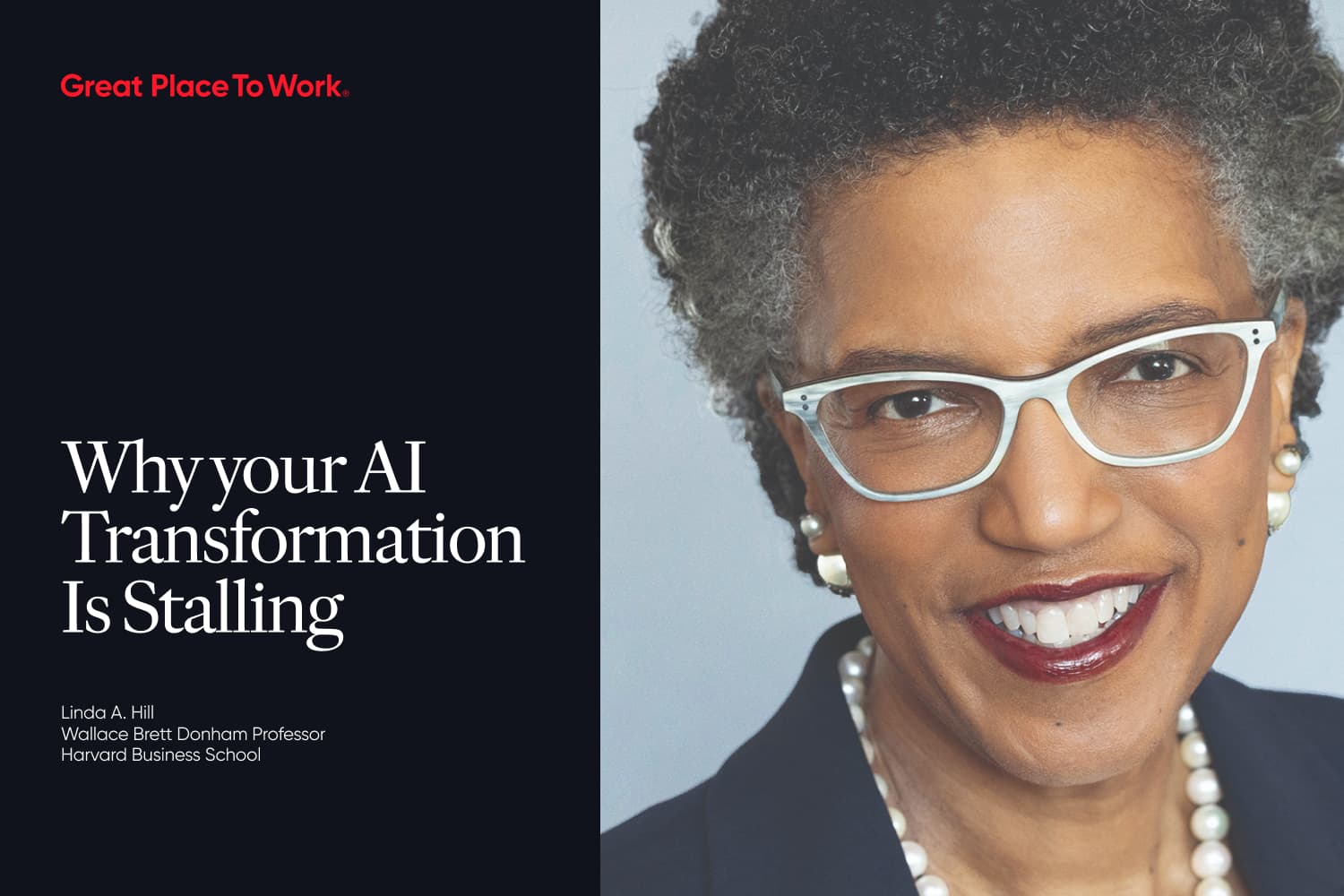
“It's one thing to generate innovative solutions; it’s another thing to scale them,” says Linda A. Hill, author of the new book, “Genius at Scale,” and Wallace Brett Donham professor of Business Administration at Harvard Business School.
Along with co-authors Emily Tedards and Jason Wilds, Hill has been asking questions about why organizations fail to innovate. Hill has deep experience on the subject, having written “Collective Genius,” which investigated how collaboration is the source of innovative breakthroughs at storied companies like Pixar, Google, and others.
Now Hill and her colleagues are turning away from Silicon Valley to look at the problems that prevent legacy companies like Mastercard and Proctor & Gamble from transforming their business.
“Leadership matters,” Hill says, and the book identifies leadership roles that either make or break transformation.
Leaders must be scientists
The first barrier in many organizations: Decisions are not informed by data.
“Even senior executives tell us they don't necessarily use data, they rely more on their experience, their expertise,” Hill says. That approach to decision-making makes it hard to experiment and discover new ways of doing things.
At Cleveland Clinic Abu Dhabi, one of the organizations studied in her book, Hill says a conscious decision was made to train people on the scientific method and approach workflows as hypotheses, not certainties.
“The CEO said to everyone: ‘There's nothing called business as usual,’” Hill shares. People had to learn to collect data on their decisions, move quickly, and get comfortable with imperfect information. In one case, nurses were trained to run rigorous and relevant A/B tests and data visualization tools to make incremental improvements in patient care.
This training is essential for progress, Hill explains: “All experiments are not equal in their rigor and their relevance.”
Getting everyone to collaborate
Great Place To Work research shows that the number of people innovating in an organization makes a big difference.
When a larger share of the workforce reports having meaningful opportunities to innovate, companies see 5.5 times the revenue growth of those where fewer employees report the same experience.
This comes down to collaborative culture, and only companies with collaborative cultures will take full advantage of the AI boom, Hill warns.
“What we're hearing from companies about AI is that to innovate, and we know this, you need to be able to co-create,” she says. Her definition of co-creation: collaboration, experimentation, and learning.
A collaborative culture is essential for speed. When employees say they can count on people to easily collaborate, they are 2.3 times more likely to quickly adapt to change, according to Great Place To Work research.
So why do companies get collaboration wrong?
They often split their company into innovators and executors, what some call the “ambidextrous organization,” Hill says. However, ideas that are born in a center of excellence or innovation lab, where some employees focus on research and development while others focus on the core business, almost never scale.
“When you go to execute … it often means that other people need to innovate, too, and do things differently,” Hill says. “You're going to have to manufacture differently, you're going to have to market differently.”
She gives an example at Proctor & Gamble where the finance department needed to learn how to change their model to fund small-scale projects. “They didn’t know how to give small chunks of money like a [venture capitalist] would,” she says. “They only knew how to give million-dollar investments.”
When everyone understands they are expected to innovate, they become more agile and embrace change to deliver on a shared mission.
The kind of leadership needed for AI transformation
Setting up a culture that fosters innovation is just one of the leadership roles Hill’s team discovered in their research. In the AI era, this kind of leadership is table stakes.
What really makes the difference?
“The Bridger role is the one that executives everywhere are telling us they don't have enough of,” Hill says.
Bridgers act as translators and intermediaries, helping two siloed groups connect to solve a common goal. Increasingly, the role extends to connect stakeholders outside the organization.
Hill points to Microsoft’s close work with OpenAI, which has brought AI capabilities into its product suite.
“Microsoft needs to have leaders who know how to co-create with OpenAI’s people — two different organizational contexts, different priorities, work styles, etc.”
The role Hill sees as the real unlock to solve complex problems like sustainability: the “Catalyst.” This is someone who doesn’t just create bridges between stakeholders, but builds ecosystems of symbiotic partners.
Hill recalls a conversation with the CEO of Renault about what it takes to succeed with electric vehicles: “It doesn't matter how good we are and how wonderful our car is, if it is not in the right ecosystem, there is no way we're going to be able to be successful.”
Where leaders should start
The first step in addressing your innovation gaps is an internal diagnostic, Hill says. “Start by looking at your own leadership.”
That means asking tough questions:
- Do we really value learning?
- Do we make room for productive failure?
- How easy is it to collaborate across differences, from team function to role level?
- Do we have leaders who can build a culture that embraces change?
Transform Your Workplace with Culture Insights from Top Experts.
Subscribe to our podcast and discover how to create a culture that attracts and retains top talent.